
What's Your Deal?: AJ Davis
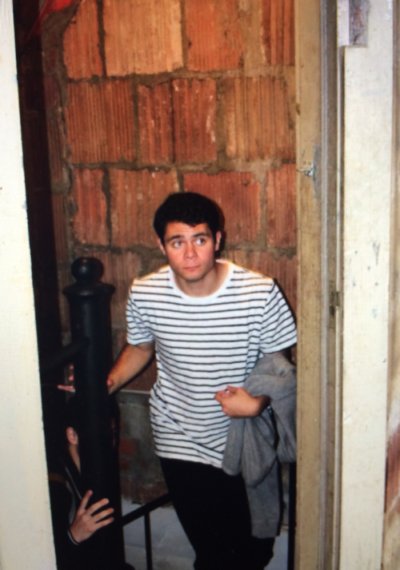
It’s easy to forget that I was AJ Davis’s Meiklejohn, and it wasn’t the other way around. Maybe it’s his status as a successful filmmaker or club founder that warrants my admiration, but I think what actually inspires me most about Davis is his genuine devotion to helping students feel welcomed and included in the Brown social scene. His club, SoBear, aims to do exactly that: create a home for a niche of our school, the substance-free community. While I am no longer his peer advisor and thus cannot force him to get coffee with me, I was able to utilize my position on Blog to score a catch-up with one of my favorite sophomores.As a substance-free student, what was your transition into the going out scene at Brown like?I came to Brown knowing I really did not want to drink. The reason I created the club is because there really wasn’t anything to transition to in terms of going out - I tried to go to parties, but that was a little weird being the only sober kid. Since there was nothing really going on besides me hanging out with my friends in my substance-free dorm--that wasn’t really substance-free--I started the club. I asked other people if they would want something like that and they were like, “Why DON’T we have something like that?!”Your club has had a huge turnout last semester, with 216 students signing up at the clubs fair and an incredible number showing up to the first meeting. Did you know there was going to be such a large population of students who resonated with the mission of SoBear?No, definitely not. I remember telling my VP Natalie [Zummer ‘19] that I would be happy if 10 kids signed up. So, how did it happen?I spoke at freshmen orientation about being a substance-free student [and not having very many social sub-free resources] and what we’re doing on campus to change that. I mentioned that we would be at the clubs fair and made a lot of very weird dad jokes. I mean, c’mon, the club has like the corniest name in the world. But then I got a lot of feedback from students who were telling me, “It meant so much to hear your experience, I didn’t know what it was going to be like going here, I’m so glad this exists.” Now, we have almost 300 people on Facebook and 160+ kids on the Listserv.
Davis and co-founder Zummer being interviewed by a local Providence news channel about their SoBear success.
Were there any initial challenges you faced at the beginning of SoBear?The main issue is money. If you’re a Category I club, you don’t get much money. We are a club based around activites, and to do that, we need money for activities. So we got $500 from a B-Lab grant. We mostly got funded by going to departments and asking for their help.From academic departments?No, actually, ResLife did an ice cream social for us. BWell did a relaxation event. SEAS gave us money. Dean Shannon O’Neill’s office has been the biggest help in terms of funds. I think it’s because our aspirations for growing this sub-free community into something that’s not stigmatized and is social is in line with her message and her work. She actually put our club in the framework of the newly established Donovan Program. Besides hosting events from laser tag to movie nights, what are tactics that SoBear’s leadership use to foster an environment of support for substance-free students?Our mission is actually more widespread than substance-free, even though the majority of kids are substance-free. We always say we are available to talk and a couple of students have actually messaged me. There are kids who come to the club who do drink but for whatever reason that night they don’t feel like doing it. Everyone wants to have fun on a Saturday night. It doesn’t matter how you do it, and that’s why some kids I know who do drink sometimes come to our events, although the majority is sub-free.How can the rest of the student body best support the substance-free community, especially when members of the sub-free community might not be open about their decision?I think there are a lot of ways to support substance-free students, but I think the biggest way is to just know that they exist. I think that’s the biggest problem. Kids will drink in dining halls [“Really?” “Yeah, yeah, last week I saw a kid drinking in Andrews!”] And it’s like with any group that has a very salient identity--it’s under the same umbrella. Substance-free, addiction, mental health: these are the new frontiers of understanding individual struggles and keeping them in mind when you are just meeting someone and you don’t know anything about them. If what you’re doing is only talking about parties and [someone is] substance free, it’s going to be uncomfortable for them. In the next few semesters, where do you see SoBear progressing?I see kids establish friend groups, I see kids who are, like, dating...I think it’s all about creating a thriving social community about sober fun. We’ve made so much progress just in the first year, but we need to keep working to destigmatize sober lifestyles on campus. Because everyone, whether you are sub-free or not, goes to college with the mindset of movies like Animal House, but if you look online, [on] 20% of college campuses the student population doesn’t drink.  You recently produced a movie focused on the story of a young man struggling with addiction. What was your motivation to explore that narrative? What kinds of messages were you trying to convey? My motivation was out of personal experience in relation to those around me and myself. I watch a lot of movies, and a young person facing a substance abuse disorder is rarely, if ever, explored. Even if it is, it is always glorified. What I wanted to convey with this film was that young people do deal with this and show what that is actually like, without any glorification. There is nothing worse than seeing a person with this disorder struggling, only to be met with Rolling Stones playing in the background when they relapse. In the face of substance abuse disorders it doesn't matter your age, it will still destroy your life. The message of the short isn't concrete; it isn't specifically about not drinking. I didn't make it to preach an agenda. It is about a single character and his struggle and that drinking/drug use would end up killing him, so he probably shouldn't do it. I want people in recovery to feel validated in their experience watching it and for those who aren't familiar with the subject matter to somewhat understand that daily struggle of trying to stay sober and failing.What was the reception of the film like among the substance-free community? The reception was overwhelmingly positive across the board. We had a premiere last fall with a panel discussion...about a hundred people came, many of whom identified as substance-free, and I think they really learned something about this topic and how it specifically relates to college campuses. Many sub-free students came up to me afterwards wanting to continue the conversation, and others thanked me for exploring this story.What suggestions might you have for any filmmakers interested in telling the story of addiction?My main suggestion would first off be to do it. This is an important topic that needs to be addressed and the more stories out there to accurately support it the better. I would also say don't glorify drinking/drug use, all it does is end up harming the people struggling with this already. Try to tell a story that is firmly based in reality to the best of your ability. My last piece of advice would be to do your research before diving into this. What I mean by that is talk to people in recovery, go to open AA or NA meetings, watch movies that deal with this to see what works and doesn't, and many more things along those lines. Through the research, someone familiar or unfamiliar with the issue that wants to tackle it will feel a greater respect and understanding of the story they are trying to tell. Do you have any last tips for sub-free students who haven’t had the chance to become involved with SoBear, primarily underclassmen?For sure. If you’re living in a sub-free dorm, try to solidify friendships with those around you and that’ll lead to a lot of opportunities. Talk to your RPLs, talk to Dean O’Neill. If you’re having problems outside of substance-use, talk to CAPS. There’s no pressure to come to any of our events. It’s like any other social event on campus, come if you want, don’t if you don’t. And that’s why I’m okay with 10 kids showing up or 70. I want to make sure that the people who are there have fun and make friends. If you get triggered by use, avoid people, places, and things. Compared to last year when I was a freshmen, there are a lot more options on campus for sub-free students.Campus resources for addiction and recovery:Dean Shannon O'Neill: 401 863-2536CAPS: 401 863-3476Student Support Services: 401 863-3145This interview has been edited and condensed for clarity. Images via AJ Davis '20.