
What's Your Deal?: Danny Schiller
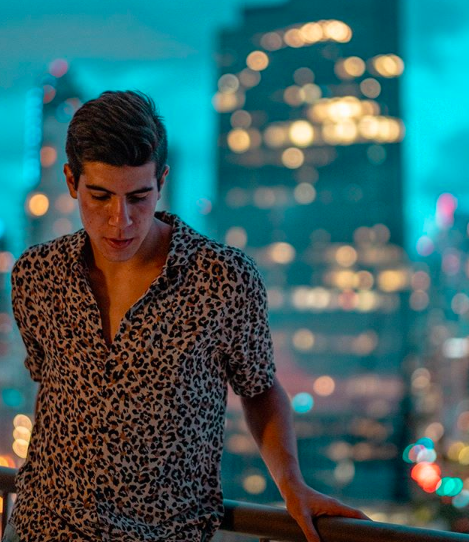
One afternoon, walking up the stairs to my room in Caswell, I heard music pouring down from the second floor. I listened for a bit and decided that liked the beat. I wondered where it could be coming from. My roommate wouldn’t be playing music that loud, I thought. But, as I have realized since, my roommate and I are more disruptive to the peace and quiet of a Caswell afternoon than we give ourselves credit for. Seriously, my apologies to everyone in Middle Caswell who hears screaming coming from the second floor—we’re not hurt, we’re just loud.
I opened the door and shouted over the music: “What is this? It’s really good!”
My roommate popped her head out of the closet. “Someone in one of my classes has music on Spotify! I had no idea, and he’s so good!”
I immediately looked the artist, Danny Schiller, up on Spotify. Since then, I have been listening nonstop to the two songs posted on Spotify: “Lo in Between” and “Ayudar.” I was thrilled to find out that Danny was releasing a new song, “Reina,” and jumped at the opportunity to interview him. I met him in the Petteruti Lounge—the only quiet place to record on campus—where I proceeded to fumble helplessly with my Voice Memo app and then record the following interview. Please enjoy, and make sure check out Danny's music—thank me later.

Gemma Brand-Wolf: Okay, so tell me a little bit about your music, about yourself. What should new listeners be looking for? What should we know about you?
Danny Schiller: My name is Daniel Enric Schiller, but I go by Danny Schiller. Keep it simple. I was born and raised just north of Chicago. But my family is from Barcelona. So a lot of my roots [are there] because I go summers and winters to spend time with family there. I think that that's reflected in my music, because [my music] has an overall Latin Pop style to [it]. However, there is a little something more to it that I don't quite know [how to describe]. People who listen to a lot of reggaeton, for example—which is one of the most popular genres in Latin America and Spanish-speaking countries—are like, 'this isn't quite reggaeton, but it also isn't quite just normal Latin Pop.' I think that's attributed to the fact that I add a sort of bilingual flair to it. Because of my American and Spanish background, I enjoy making my songs in both English and Spanish. It shows both sides of me. I think a lot of people can relate to that.
[In terms of] artists who I use as influence, one's definitely Rosalia. She's one of my creative influences, for sure. I also grew up listening to a lot of R&B and Hip Hop. On the Pop side, I'd say [my influences are] Rosalia, Ozuna, and Bad Bunny. Those are three artists that I love to try to encapsulate in any way I can. Vocally, I love just any R&B and Hip Hop influences that I can sort of try to mesh into that.
Most of my songs are related to my emotions and relationships in general. I would say that they are emotional songs, but they're not really too sappy and they're also not too poppy. It's sort of a nice in between.
GBW: Yeah, I see what you mean. You're very much within the genre, but you're kind of, like you said, your own thing. I really appreciate it, and I imagine other students on campus would appreciate it. What does it feel like to be performing and producing music on campus, for a mainly student-based audience?
DS: I definitely think it's a really unique experience that most artists don't have unless they go to college—you have this really tight knit community of people who care about you and people who don't know who you are. But the thing is, a lot of circles overlap. If somebody does know me, maybe their friend knows me. And if their friend says they like me or posts me on social media or something like that, then they end up getting to know my music and therefore getting to know me. And then we become friends through the music. So it's actually an interesting experience—there's an aspect of being a supportive fan—but then because you're in college you can also forge more personal relationships through the music. Which I really value a lot because obviously music's great, and if you support my music, that's great. But we're both human beings. So it's really cool to have that personal connection that comes through just having created a song.
I also think another cool aspect about being in college is that everyone here is super creative, especially at Brown. We're all good students, obviously, that's how we ended up here. But there's something special about us that got us into Brown. We value the arts more than other institutions. I feel like every student, no matter what you study, might have a little bit of an art background, whether it's graphic design or making music or videography or fashion. What's cool here is that you have this community of students who all value the arts in a certain way. And any interaction you have with someone may be able to enhance your artistic experience. For example, I might just be talking to someone and they say, 'Oh, I make videos,' and I'm like, 'Oh, I make music.' And then we end up making a promo video, for example. That just happened from running into each other in a hallway or somewhere on campus, things like that.
GBW: That makes a lot of sense. So how much of the message of your music is due to who your audience is right now? That is, students. I'm also curious more generally—what are you trying to say with your music?
DS: I don't really manufacture the meaning of my music for people who are listening. I definitely try to create a sound that I think people would like—I definitely try to make a sound that people who I want to enjoy the music would enjoy, you know what I'm saying?
GBW: Right, that's different from manufacturing.
DS: Exactly. So that's just in terms of...phonetically and sonically. Sonically, I do think of the people around me and how they would enjoy it. Like if this is meant to be a party song, is the rhythm right? Is the beats per minute—the BPM—is that fast enough or slow enough? Are the melodies that I'm trying to forge, are they too poppy or not poppy enough for the purpose I'm trying to achieve. However, in terms of meaning, I'd say they're all pretty personal. I have a journal where I just sort of write feelings that I have. It's sort of like a diary. I start off with just writing how I feel or just writing anything that's on my mind at a certain point. Then let's say I like an idea, [I'll talk to] my producer Baird, who is a godsend—he's the only reason that I'm making music basically—I got to give Baird a shout out. Y'all should check him out.
GBW: He graduated from Brown, right?
DS: Yeah. He was a point-five-er. He did his last semester this past fall. 2019. He was in Mexico City for a semester abroad. Now he's making his music. He's about to release another project. Y'all should peep that.
But, yeah, so Baird will send me a bunch of guitar loops and it'll start like that. [Just] him messing around on the guitar. If I like that idea and I feel like it meshes well with an idea that I wrote down, then I'll start to write lyrics to it, and then if I can come up with melodies—they come pretty easily if I already have the guitar loop—then I'll just move in that way. Sometimes it'll become a song, sometimes it won't. Then we move into recording stages. I definitely think it starts from a very personal point—the meaning of my music isn't made for anyone in particular. But I feel like a lot of people can relate to it.
GBW: Right. And you said you think that's because it's like there's two different sides of you that you're speaking to in your songs. What is it like in general to be a musician, a student, a person in the middle of those two sides, especially having found such a powerful way to bring them together?
DS: I was actually just talking about this with someone the other day. The reason I'm here is because I play soccer on the varsity team. So, I play soccer and there's the student and now there's the music side, too. And then my family and everything else. There are all these aspects of myself that seem really not related. But what I've realized in making music is that a lot of lessons that I've learned through each of those parts of my life and a lot of values that I've gained from these seemingly opposite parts of my life tend to merge pretty fluidly when it comes to making music. All the values of discipline and everything that I get from soccer, I apply to the music making, because if you're not disciplined, then really easily you could start a project and not finish it. You know, create something that you're actually proud of and leave it like that. I think like values, the discipline that I get from soccer especially, are definitely present. In terms of being a student and also being a musician, I think it's a matter of being critical of yourself and also being really thoughtful. [There] are different parts of my life that, even though they may seem unrelated, I think when it comes to making music, they all merge pretty fluidly.
GBW: Yeah, that makes sense. How did you originally get into music?
DS: So, making music is a different story, but I'll start with just like my love for music in general. My family is very musical. My sister is actually—she's the singer of the family, which is funny. She's the musician of the family. She did undergrad at Northwestern and studied music and psychology. Now she's at Oxford studying musicology. So music's her thing. She's also a jazz performer and she's classically trained and all that. I've been the soccer player and she's been the musician and musical academic. But [I've] been singing my entire life. You can ask my mom, driving me to soccer practice—the amount of times I'd be like, 'turn the music louder!'—[Music has] always been super present in my life. Once I got into middle school, high school, I started taking voice lessons to get classically trained. Then I was in choirs, things like that. I got to high school, joined a couple a cappella groups.
Once I got to college, I was like, 'I don't know if a cappella is my thing,' but I definitely wanted to start creating music because I was kind of tired of singing other people's songs, you know what I'm saying? I felt like I wanted to take a stab at making my own [music]. It was actually a teammate of mine named Will Van Zandt, who's out in L.A., he's a producer. He was a teammate, and we were just messing around, he showed me some beats. I was like, 'do you think I could write something to one of these.' And he was like, 'yeah, of course.' He sort of opened the door to the Brown music making scene.
Then I started to meet so many people and I realized what an active music making environment Brown is, which most people don't know, unless you're in on it. But now I feel like people are starting to release more stuff, which is awesome. Brown is an awesome music creation scene. I think the really big thing that led to me starting to release music that I made was meeting my friend Baird. [...] Obviously we're friends first, but he's an incredible musician and an incredible musical mind. He contributes through writing—we co-write basically. I'll usually write lyrics, melodies, and he'll write the guitar and production. So he'll produce, co-write, engineer and do all that. [Baird] was probably the biggest staple in my Brown career, leading to starting to release songs. I always tell people he's the Wizard. I'm just the guy singing who happened to stumble upon the right producer.
GBW: What does it feel like to release a song?
DS: If you're releasing into all platforms, for example—I'm just going to get into the technical aspect of it first—if you're releasing on SoundCloud, that's a music platform where you don't need a distribution service, or YouTube, these are free. You can just create an account, upload it and release it to the world. And it's just like that. *snaps* Then there's this other aspect of it—if you try to get on other platforms like Spotify, Apple, Music, you have to use something called a distribution service. And so that's basically just a more official way—you have to get approved and all these things, and then it gets, you know, approved and sent to these music platforms through the distribution service and then they have to process it and then you send it to their editors to hopefully get on a curated playlist. All this is to say that it's a super technical and complex process. It's not like I'm, 'I like to sing and I make a song and I release it.' You know what I'm saying? If you're trying to do it right, it's gonna take a lot more thought and effort than that.
For example I submitted “Reina" over four weeks ago. It's been in the works for a long time, you know what I'm saying? [This] is a very thought out process. It's a lot of work but it's really fun work. It takes a lot of effort and thinking in advance. And if you're doing it independently, it requires you to wear a lot of hats. So not only am I writing, recording the song, and working with producers to make a song—that's its own beast—and then, for example, you got to do artwork. So I got to go to a photo shoot and stuff like that. Try to put my own creative spin and try to work with the photographer to find something that we both like and we think represents the work. Once you do that, then you can submit it. And then that's a whole 'nother process through the distribution service. After that, if you want to do promo, right? Then you maybe want to do, let's say, a video. I love doing a little promo videos. I think it's really fun, first of all, and I think viewers appreciate it, you know? And so I'll go and do that—shout out Sam Rochelle because he's been killing it—he did the one for “Reina.” That's a whole other process of recording [the video] and then editing it in the same way that making music itself was a whole process. So blah, blah, blah, then getting the word out to people. That's a whole 'nother beast.
I've realized now through releasing a few songs that trying to get people to listen, whether it's just people in the industry or people who enjoy the music, that's a whole 'nother beast in itself. [...] Basically, it's a lot of self-marketing because you're a commodity that you're trying to get people to invest in, you know. [...] All of this is to say that there are so many hats that you have to wear when you're releasing music and it's hella hectic, but once you release it—like right now I'm feeling like on top of the world, especially when I see that I'm getting responses from people that are like, 'yo, it's so dope.' And they're reposting it, and showing it to people, sending me personal messages like, 'yo, you know, I don't think you get it, how much I appreciate the sound of this and the meaning behind it.' That's super special's me. To be honest, you could go do all that work, and if one person responds with praise, it feels great. That's enough, to be honest.
Going back to like the technical aspect of it—in the music industry, there's a whole team of people doing each of those jobs. So the marketing, there's a whole team behind an artist doing that. The videographer, [it's] their own job, you know. There's someone producing, that's their own thing. [There] are usually people writing the songs for these artists. But I think doing it independently and having your foot in each of these artistic processes is really fun, really useful, but also really taxing. But at the end of the day, I think it's very worth it.
GBW: So tell us a little bit more about your new song, about maybe what you're doing next. And then also, if you want to tell us a little bit about what you do here at Brown. Are you looking in to going into music? If so, would you want to be in all these different boxes? Basically, what's happening now and what's going to happen?
DS: Well, 2020 is definitely going to be a year of a lot of content. I created a lot of content already and it's only February. So it's just a matter of rolling it out properly and releasing it the way I want to release it in a way that will hopefully be enjoyed by anyone listening or watching. And that hopefully will spread, because at the end of the day, that's also a goal of mine, is to have as many people enjoy it. I guess I started in 2020 with a little YouTube series that I'm calling “Barcelona Live Sessions,” because over winter break, I was like, 'I'm here right now. My cousin's a filmmaker and he also plays guitar. Let's just roam around the city of Barcelona, that I love so much and hit these interesting locations that are aesthetically pleasing, too.'.
GBW: I think I saw one on the beach.
DS: Yes, that one. That was to "Eclipse." So I released that. It was 24 hours where we just brought a change of clothes to make it look like I was in different days. I was just roaming around the city, playing in public spaces. And we had a little microphone to capture sound properly.
GBW: Now I know the secret. It was just one day.
DS: Yeah, exactly. Jeez, I gave myself away. So that was really fun, ‘cause we were just playing in front of random people. It was just fun to roam around the city with my cousin. And we ended up making a full series of videos. So I released that. And then I released "Reina," which is a big release. This has been pending for a long time. We actually recorded this back at Senior Week last year and we just haven't released it since then. Then I have some shows coming up and in addition to that, like the next part of the "Barcelona Live" series is going to come out soon. And then I have a whole bunch of songs, because like I mentioned, Baird was in Mexico City last semester. So that whole time that he was in Mexico City, we were writing things. He was sending me guitar loops, I was sending him lyrics. We were FaceTiming and doing writing sessions coming up with—basically writing full songs. In January, before school started, for like seven days, he and I came to Providence and he just crashed in my place. And we just—all the songs we've written—we just tried to pump them out as best as we could and we ended up making six songs in like a week, which is unheard of for the amount for quality that's produced. But I think it really helped that we wrote them in advance. [...] So I have a ton of content and like I said, it's just a matter of rollout and like figuring out the right promotion strategy, like marketing route, things like that.
GBW: [...] Are you a senior? I don't want to, like throw that question at you. But you can answer however you want to.
DS: Nah, you're chilling. That's heavy, but [—] basically, I can't think of anything that would make me happier in life than creating music and being able to make a living off of it, you know, or just survive off of that. And I think that would be such an incredible experience. But I also know that it's going to take a lot to get there. What I think is going to happen is I'm going to go to a city. Don't know which one yet. Who knows? Honestly, just keep creating music because I feel that the quality of music that we're creating and the amount of fun that I'm having creating it is worth further pursuit than just leaving school and stopping, you know?
GBW: Cool. That's exciting. Do you have any advice you want to give other musicians on campus?
DS: I would say before you just start releasing things. make a lot of things. [I] think that creating a lot allows you to forge a sound that's your own. [Also,] where I am is nowhere close to where I want to be in the near future [and] I think there's a pretty far away horizon that I want to reach. So that's just to say, whatever I say, take with a grain of salt because I'm not where I want to be. But I would say just create a lot because then you can sort of trial and error and figure out what's good for you, what's not good for you. And then also just enjoy having all this support around you. And if you enjoy performing, go and perform. If you enjoy collaborating with people, go out and collab. Because we're in an environment right now that I've heard from people who have already left college and that I've realized. We're in an environment that doesn't exist anywhere else, where people are solely here to learn and better themselves and do things they enjoy doing for the sake of their own enjoyment. No one here is going to ask you, like, for a studio session where you guys are just going to mess around and be like, 'all right, that'll be fifty an hour'—that would be ridiculous. Take advantage of the fact that everyone here is passionate and sort of let yourself be passionate and feed off the passion around you.
With that, we parted ways. When I pulled out my phone and plugged in my headphones, I opened up to Danny’s new song, “Reina,” and have not stopped listening since then.
You can find Danny on Spotify, Apple Music, SoundCloud, YouTube, Facebook, Instagram, and somewhere on campus!