
SATC: Curtain Call
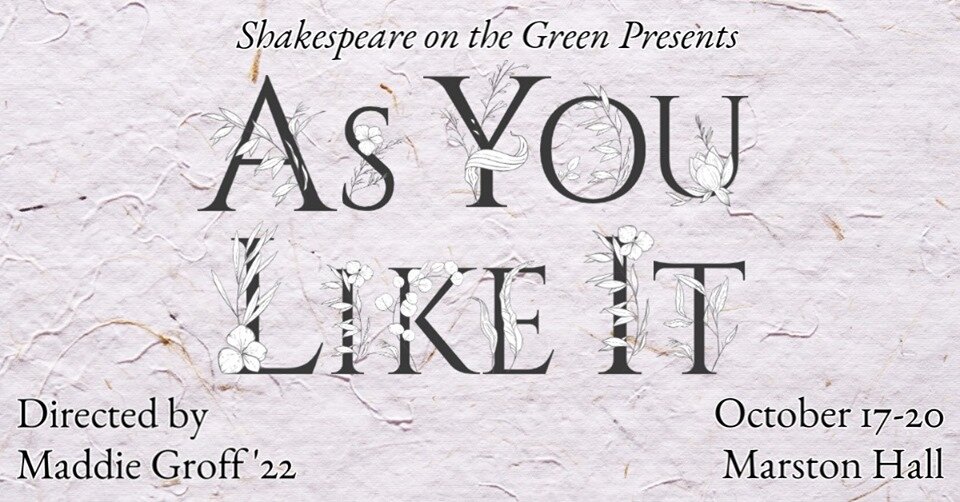
“You know, I think comedy can be so profound,” my friend joked as she led me to my seat in the front row. I looked around the entrance lobby of Marston Hall, the beautiful home of the Slavic Studies department. Paper trees and leaves covered the back walls and glowing stage lights brought me off campus and into the Forest of Arden.
I was there to see Shakespeare on the Green’s production of As You Like It. I had friends in the show and I was excited to see them perform. I was excited for two hours of royal exile and laughable miscommunication and love at first sight. I was also ready for theater to give me my friends back, as they would no longer have rehearsal for unfathomable lengths of time every day. I was not, however, prepared to be sitting in that front center seat trying not to cry as the show came to an end and the actors danced across the stage for curtain call.
I congratulated my friends, a big smile on my face, and thought about the show’s characters and plotlines, its schemes and scandals. As a modern audience member (who admittedly did not catch the meaning of every old English line), the predictability of such a Shakespearean comedy was exasperating at times; everything always works out in the end, and it can sometimes be hard to watch the convoluted means through which each character concludes the night beside their appropriate counterpart (especially with Shakespeare’s almost painful commitment to heteronormativity). Why, then, was I so moved by the show?
The comedic show was, as my friend said, profound. Theater is an extremely important medium of communication, and is often an avenue through which to tackle difficult and far-reaching issues. A lot of the productions on campus take a heavier tone and a more direct approach, my friend told me, and it is sometimes easy to forget how important a comedy can be.
Of course, comedy has always been used for social and political critique/coping (think: SNL, stand-up specials, etc.) But As You Like It didn’t feel especially relevant in terms of its political commentary, and it certainly speaks to the social atmosphere of a time long past.
As I watched the cast join hands and dance together around the stage, I wondered why I felt such nostalgia for something that I had never experienced. Obviously, I was not alive in Shakespeare’s time. While I had been a theater kid in high school, those days felt so far away, and I definitely wasn’t close to tears remembering the joys of being sixteen.
I watched the cast take their final bow and it hit me: in the on-stage world the cast had created, everything simply worked out, and in real life, it’s just never that easy. Looking around, I thought my fellow audience members might be thinking the same thing. I felt closer to the audience in a strange way, as if we had all just gone through something together, something more than just a student production on a Thursday evening. Maybe they, too, were responding to what felt to me like an innate human quality, a collective wish that life will work out.
Ok, bear with me while I make this transition: I was talking on the phone with a friend the other day, and she was explaining the weird mood she has been in recently.
“It just seems that no one’s really consistently happy,” she said, “there’s always something going on to be stressed out about, or sad about, or whatever.”
I’ve definitely had that thought before. There are times when I just get exhausted, when I look around and wonder if all this stress -- over school, family, friends, relationships -- is really worth it. In real life, things don’t seem to resolve themselves as cleanly as in Shakespeare’s comedy.
The combination of the actors’ impressive performances, Maddie Groff’s (‘22) skillful direction, and the production team’s dedication made SOTG’s As You Like It a wonderful show. I could tell how hard the cast and crew had worked, not only because I knew my friends had been staying up for 50 hours at a time since tech had started. The most powerful part of the show was the curtain call, when they all stood on stage together, joined by hands and by weeks of rehearsal. It was a kind of celebration, their curtain call, an elated moment of accomplishment and community, and I felt lucky to be let into their world.
No matter what it is we’re aiming for, whether it be the Elizabethan ideal or our college degrees, there are moments along the way when things do work out. In the middle of it all, there are moments, such as the curtain call at the end of a show, when we can and should take the time to congratulate ourselves, to feel good about the work we put in and the results we got, both expected and unpredictable.
Sometimes it feels like nothing’s going right, and sometimes life can be shitty. Things don't always work out, and that’s okay. When they do, we sometimes forget to let ourselves take that moment of celebration. Either way, what counts is who I’m working with, who is beside me at curtain call.