
SATC: City of Stars
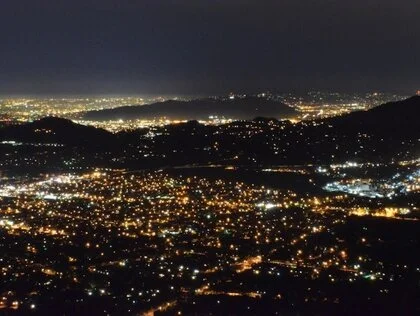
When I landed in LA, I walked through the airport in a daze and ended up waiting at the wrong baggage claim terminal for twenty minutes. In fact, it took me so long to realize my mistake that my bag had been sent to the information desk, and I had to hunt through the airport to find it. Stepping outside was a complete sensory overload. The air in LA is thicker, both with pollution and noise. I threw my duffel bag on the curb and sat down on top of it until my dad and sister drove up. I was disoriented and overwhelmed, even as I got into the car, even as we started driving home. It wasn’t until we crested the hill that leads down into the San Fernando Valley (that’s right, I’m a tried-and-true Valley Girl) that I felt like I was home. At the top, the mountains fell away, and the Valley floor, flooded with light, opened up below us. The light seemed infinite, each one the tiny pinprick of a million people's lives. You can see the stars in LA, I think, they’re just upside down; they’re the reflection of light on water, in some ways more beautiful for their slight distortion. A friend of mine has a theory about coming home: every person, he says, has an image that means home is close, that means their journey, however long or short, is nearing an end. My image of coming home is the horizon of lights seen through the windshield of a car speeding across the 405. Driving over that hill felt like letting out a deep breath. It also felt like entering a spinning vortex of memory, a million times the sensory overload of the LAX departure terminal. Not to be dramatic.I remembered the time my car broke down right at the top of the hill, just barely catching the downward momentum that would stop me from rolling backwards. I remembered the bus ride to and from school every day, an hour in each direction (if traffic wasn’t that bad). We kept a list of bizarre freeway sightings: a carousel (pastel horses spinning slowly), a busted fire hydrant flooding a car near an onramp, and, every now and again, a car on fire, flames licking at metal and dry desert asphalt.There was that one boy I dated in senior year who drove me up into the Malibu hills in his fancy car, bragging about spinning donuts with his friends in the Ralphs parking lot. In the summer, I would kick my feet out of the car window, the wind whipping off the ocean as my friend sped down the PCH, tapping me every time she needed to use her right-hand mirror. I failed the driving test not once, but twice (I can explain). Once, I woke up at a friend’s house after a night-out-gone-wrong to find that my car had been towed. A few months earlier, I had refused to give a friend her keys, despite her assurances that she had only had one beer. So many nights spent “scream-singing,” so many hours stuck in rush-hour. Songs I associate with specific streets, specific people. A tendency to save tears for the safety and privacy of my anonymous white station wagon. The loneliness and isolation, the friendships and roadtrips and traditions. If I counted all the lights painting the Valley floor, I would still have more to remember. And that’s just counting everything that's happened in cars.Everyone has a different image of coming home. My friend told me his is of the lamp posts that line his street; whenever he sees a lamp post, he thinks of home, and he judges (perhaps unfairly) the place that the lamp is located. Whatever your image is, it carries a lot more than just the feeling of coming home. Whatever you’re coming home from, it’s changed the way you see, even if only slightly, and the image holds that change, reminds you of it whenever you drive up over that hill. You might not have gone home for spring break. Your definition of home may no longer be the place that you grew up. Either way, you’re accumulating memories that will change the way you think of home, the relationships you made there and anywhere else. Even if you don’t realize it, even if it doesn’t have anything to do with driving.Instead of thinking of home as landing at LAX, I’m going to think of it as the man-made stars of the San Fernando Valley; instead of letting all this memory be overwhelming and disorienting and exhausting, I’d rather see it as the infinite reflection of everything I’ve done, distorted slightly by time.