
Dr. Howard Frumkin on Human Health in a Changing Climate
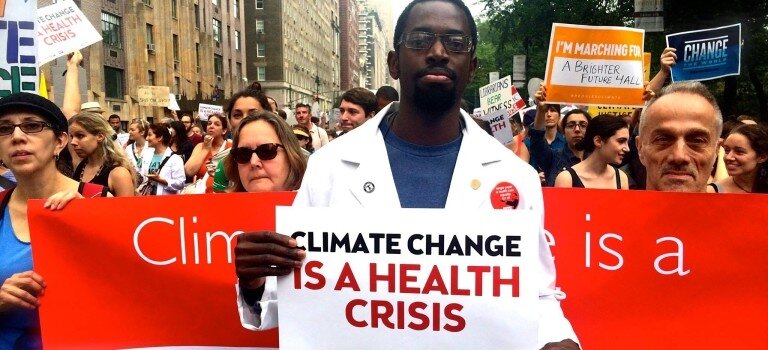
“Climate change is the biggest global health threat of the 21st century.” On Friday afternoon, Dr. Howard Frumkin, professor of Environmental and Occupational Health Sciences at the University of Washington, delivered a lecture on the potential effects of climate change on human health. Focused on solutions, Dr. Frumkin gave the audience an optimistic approach to the pressing issue. He began the lecture ominously, showing a picture of a man in a powdered wig smoking in a coal mine. Although he followed with a brief discussion about carbon dioxide levels, Dr. Frumkin’s quickly segue'd to the changing climate's effect on health.Dr. Frumkin started by discussing heat--which can cause heat rash, cramps, exhaustion, or even deadly heat stroke. He even showed the audience an image of a morgue in Karachi, Pakistan filled with victims of the country's 2015 heat wave. He noted that during heat waves, violence increases, kidney disease becomes prevalent, and food sanitation is hard to maintain. However, he also reassured that--given scientist's knowledge of heat wave tendencies-- humans can form strategies to protect themselves.Dr. Frumkin also spoke about other severe weather events like heavy precipitation and increasingly powerful storms. “Many of these events are becoming more common”, he said whilst pouring rain and treacherous winds wreaked havoc outside. He noted that rising sea levels put coastal cities in danger of the higher flooding that comes with increasingly deadly hurricanes and storms. However, the impact of such storms is not just physical. Displaced people often struggle with mental health issues for years after the event itself.Moving on to the issue of deteriorating air quality, Dr. Frumkin spoke about respiratory irritants formed in the atmosphere from industrial pollution and wildfires. He discussed how droughts, global warming, and desiccation of land promote these large forest fires. He also pointed out that these pollutants worsen allergies.Dr. Frumkin further spoke about the transmission of infectious diseases by mosquitoes and ticks that thrive in warmer conditions. Indeed, global warming has led to an increase in Lyme disease, Dengue, West Nile Virus, and other waterborne and food-borne diseases. Dr. Frumkin also noted the threat of diminished food production. Most crops don’t do well in a rapidly changing and inconsistent climate, meaning much of the world will face increasingly unreliable food supplies and the instability that comes with it.Dr. Frumkin ended his lecture by discussing optimistic solutions to the crisis such as innovations in electrical vehicles, the resurgence of biking, and smart neighborhood design. He praised China as a world leader in renewable energy and applauded America's increasing use of solar and wind energy.Asked about strategies for spreading awareness of the threat to the planet, Dr. Frumkin said, “Simple, clear messages, repeated often, from a variety of trusted sources.”