
Margot Lee Shetterly, author of Hidden Figures, comes to Brown!
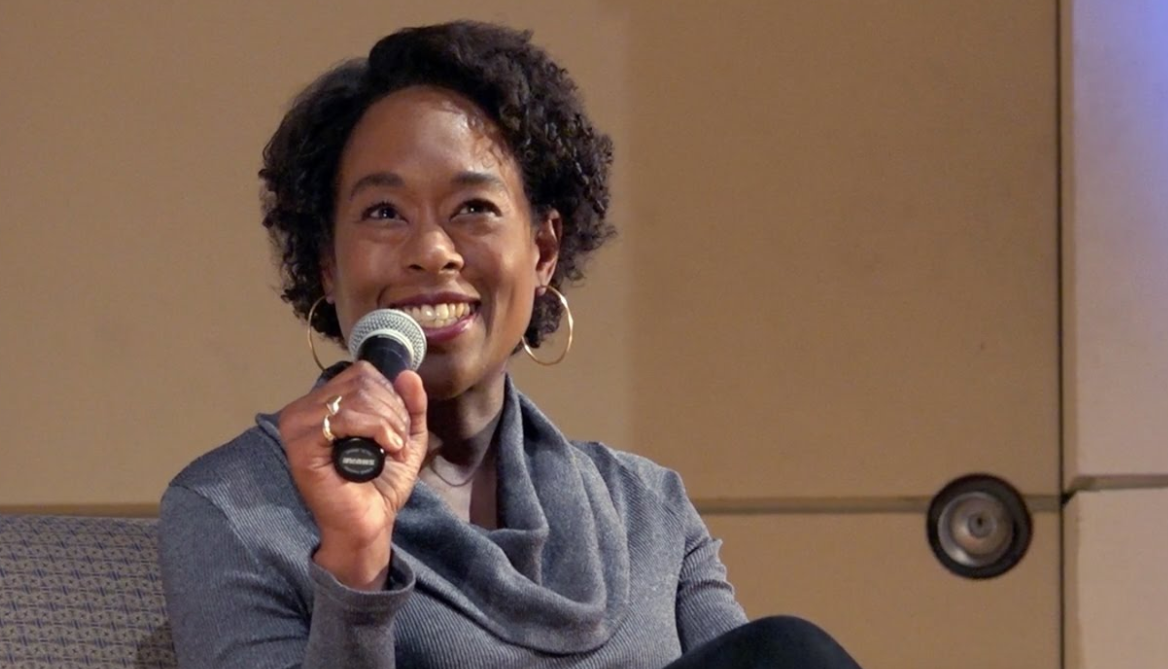
Last Monday, Brown was fortunate enough to welcome Margot Lee Shetterly, the author of Hidden Figures. Shetterly's book not only reached bestseller status but made waves at the box office as well, with its film adaptation earning three Oscar nominations—including one for Best Picture. Shetterly hit on a variety of topics, including race, gender, the power of stories, the extra-ordinariness of ordinariness, and growing up. Here's what she had to say.On growing up: Shetterly grew up near Hampton, Virginia, home to the Langley Air Force Base, NASA Langley Research Center, and the Virginia Air and Space Center. As a result, encountering women in the STEM fields—including women of color—was not an unusual occurrence for Shetterly. "They were for me, growing up, as normal as the teachers and the bus drivers, the lawyers and construction workers and military people, the shipyard workers who were also part of our community there," she said, when talking about female scientists. "There was no cognitive dissonance when I heard the words black and female and mathematician and realized that they applied to one person, not three different people."On modern blind spots: But the women featured in Hidden Figures remained hidden even from Shetterly. "...I have to admit that for years, basically for most of my entire adult life, these women lived in my blind spots," she said. "It took me a really long time to see them as they deserved to be seen and to value their contributions to their community, our country, and to science and engineering. I was living next door and it still astonishes me that I did not at an earlier point in my life realize just how extraordinary the people were who were living next door to me."On the idea for Hidden Figures: Shetterly admitted that she took the work of these women for granted for most of her life—until one day, when her father casually mentioned Katherine Johnson's name. Shetterly's husband was shocked, asking why he hadn't heard of her before. This set off the spark that Shetterly had been waiting for. "I should know their stories!" she declared, in December 2010."Really, though, every story has its own time and I think that it’s only now that our eyes are sharp enough to see their accomplishments and to appreciate their lives and their work. To see them as they truly should be seen—as people whose contributions altered the course of American history."On extraordinary "ordinary" women: "There’s an aspect to their hidden status that I actually think of as something of a silver lining. This is a story about a group of women. They were part of a vibrant community and workplace that also employed other people like them. We love 'first and only' stories, and this does not fit that mold. They were exceptional—that is true—but none of these women had to be the exception, the only woman, or the only black woman, in their workplace.""The way I like to think of them is extraordinary ordinary people. Hardworking achievers who are nonetheless unassuming and very low-key about their work. If you heard about what these women were doing, the likelihood is that you did not hear it from them directly." They were known as PTA mothers, neighbors, church piano players. These women wanted to be part of the community, not apart from it. On the meaning of Hidden Figures' motifs: The theme of "looking beyond" runs through the Hidden Figures movie, and it has a double meaning. On one level it involves calculating the trajectory of space flight, but on a deeper level, it involves women in science. When the door opened for women to be professional mathematicians, they themselves were ready, but they still had to convince their colleagues to look beyond their races and genders. And what's more, in another sense everyone involved had to look beyond: into space, into this unprecedented mission into the heavens, as agents of social change.On Shetterly's favorite movie scene: "There are a lot of moving and important scenes in the movie, but I think the one that gets me the most every single time is one of the simplest," Shetterly said. "It’s the one that happens in the beginning, and that is when the young actress playing Katherine Johnson is just standing at a blackboard, with her big glasses, just like I had when I was seven, and she’s factoring quadratic equations." The scene has a powerful simplicity.On that really weird John Glenn scene: Apparently, the real-life version of the spectacular scene with John Glenn was not as dramatic as it was in the movie, where, at Glenn's request, Katherine Johnson scrambled to check the numbers just minutes before launch. Nevertheless, Glenn did know of Johnson, and he did request that she check the numbers on the launch—he just gave her a little more time than the film indicates.On the American Dream: "I think that the power of the American Dream is that it too is a story, as much a myth as it is a reality, something that we tell ourselves about how we live and what we believe and what we think is possible. It was really important for me that the American Dream be part of the subtitle of the book because Hidden Figures is a story about the importance of including black women in the American Dream."On the power of stories: "Though Hidden Figures has particular resonance for black women, this story is a broader story that is relevant to women of all backgrounds, who are struggling to narrow the gap between their abilities and their ambitions, and society's perceptions of them."Images via and via.