
Better World by Design: a recap
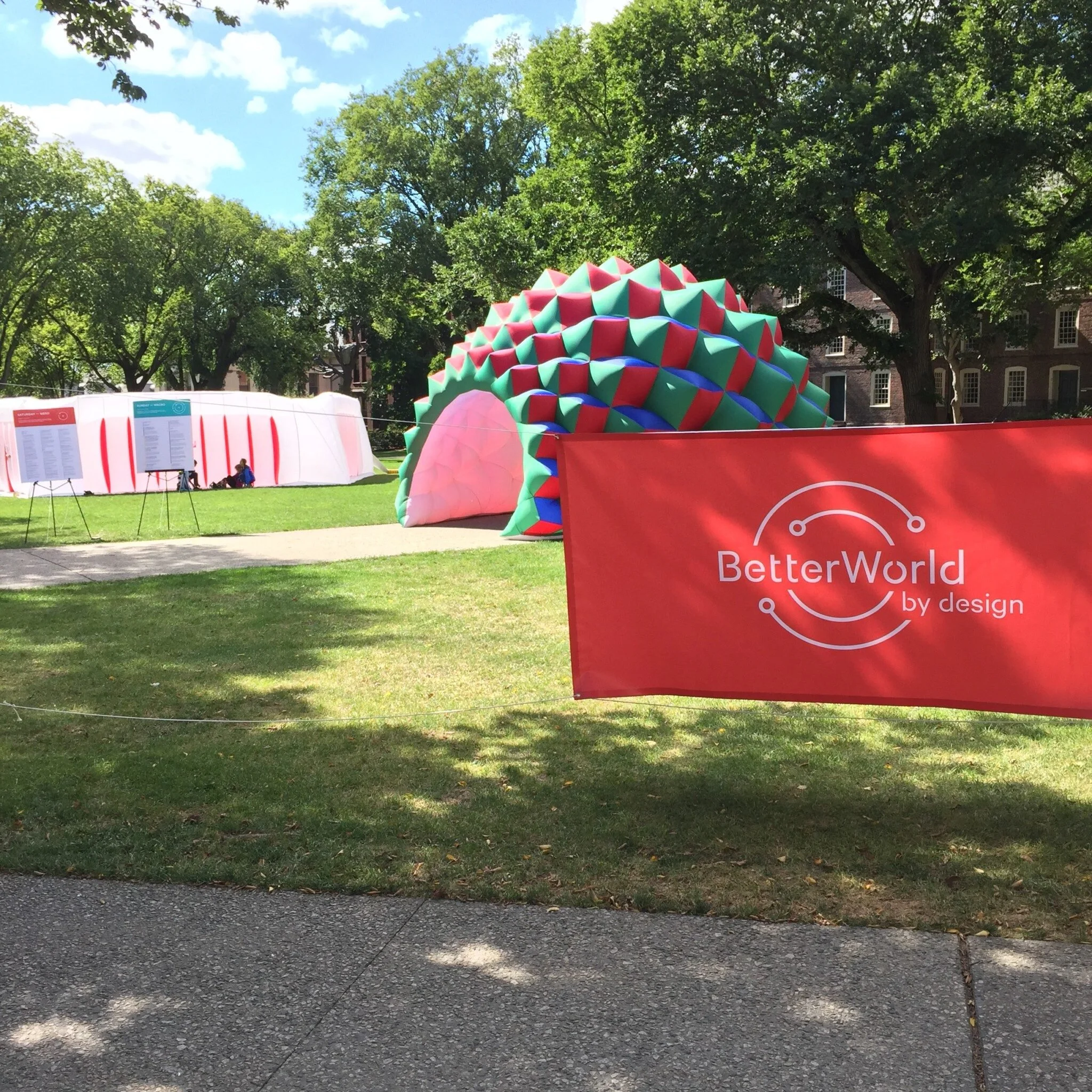
Woke up in the morning, feeling very much not like P. Diddy, but I did end up at Better World by Design. And in my book, that's basically the next best thing. Why? Because who wouldn't want to spend three days at workshops, panels, and discussions about interplay (design from an interdisciplinary perspective), this year's theme? Just in case you missed it, here's a quick recap of Saturday's events.  Keynote Craig Dykers, a founding partner of the majorly-cool architecture firm Snøhetta, kicked off Saturday's conference with a speech. He discussed fascinating architectural projects projects such as the Great Library of Alexandria, the Hunt Library (which has a book robot!), and the reconstruction of Times Square. But the most interesting part of his speech was when he analyzed the concept of "habitat." He discussed his team's design of "sexy beehives," aimed to fight a declining bee population. He described another one of their projects, Norwegian Wild Reindeer Pavilion, which allows visitors to enjoy nature without disturbing it. Dyker also spoke the truest sentence known to man—"Controlled bird poop is sort of nice"—when he showed us a new structure that can be inserted into buildings' facades, providing a place where birds can nest without ruining the aesthetics of a building.Conversation: Autodesk Education Design Challenge Launch, "Reimagining Food Systems"After the keynote, I attended a conversation on food systems that explored questions about "Big Food" (the cheap food industry), local approaches to food, and how to make an impact through food. The diverse range of speakers enhanced the quality of the talk. They included: Daniel Sheehan of Humbie Pie Company, which is based in Providence; Kellan Hays of Zasaka, a non-profit that works on agriculture education in Zambia; Lisa Raiola of Hope & Main, Rhode Island's first-ever provider of culinary business incubators (that's right! incubators aren't just for new tech start-ups!); and Megan Kelly of Brown's Food Recovery Network.
 Lecture: Designing for Hope & HealthSamantha Dempsey of Hennepin County Medical Center and Olga Elizarova of Mad*Pow held a lecture about human-centered design, specifically in medicine. They explained concepts like co-design (working with the intended user to design their product) and health equity (eliminating systemic differences in the health statuses of people). They also gave us a brief explanation of their respective projects. Dempsey works with recovering high-school addicts in order to determine how to better educate young adults about addiction, while Elizarova's project investigates strategies to decrease no-show rates in clinics. Lunch and ExpoThe expo showcased various design-focused groups. Highlights included RISD's The Cook Book (represented by Michelle Devlin '18 Graphic Design and Hannah Kim '18 Film Animation Video) that creates a magazine comprised of curated art, design, and prose, all relating to food and recipes collected from the student body. (Their current logo involves cheese puffs.) Ellen Taylor '17, an MCM concentrator, represented Drøme, a women-curated artist collective. Although they are currently limited to digital means, they have a magazine coming out soon. Their blog is definitely worth checking out—it's visually stunning and educational. Last but not least was RISD IDSA, which hosts workshops and panels featuring professionals from companies like Pinterest and Yelp. Their events are open to Brown students. Keynote Conversation: Participatory Design in the Field of HealthThis conversation featured the aforementioned Olga Elizarova and Samantha Dempsey, as well as Hannah Chung, co-founder of Sproutel, and moderator Leslie Fontana of RISD. It aimed to define participatory design and explore the designer's role through such a process, especially in the field of health. Workshop: Mending the Gap: Re-imagining the 6-10 Connector to Build More Livable NeighborhoodsThe 6-10 connector is a highway that cuts through several Providence neighborhoods. Because it's slated for immediate structural repair, there are a lot of possibilities for re-design that would make it more community-friendly. During the workshop, participants were asked to split into two groups. One group was responsible for re-designing the connector itself, making it more environmentally friendly and economically sustainable. The other group figured out what to do if a bridge had to remain unchanged, keeping in mind health issues from car emissions, traffic flow, and neighborhood separation. The real-world relevance of this workshop made it one of my favorite parts of the day. For more information, you can go to providenceri.gov. Workshop: Y Center: Generating Relevant Community SolutionsI have to admit that I actually came here by mistake. But that mistake turned out to be a fruitful one, because the workshop, run by Dhairya Pujara, founder of Ycenter, was absolutely fantastic. He taught us about critical-thinking in community-centered design by relating his work in Zimbabwe, where he developed what is essentially Uber for malaria, an initiative that helps people get access to malaria testing. But he had failed to understand one detail that was instrumental to the design: people didn't know when it was appropriate to use his program. He explained how he relied heavily on the community to help produce a solution: Project Aurora, a simple card game that slowly changes consumer behavior by teaching malaria symptoms. Images via Claire Pang '19.