
An interview with #BlackLivesMatter co-founder Opal Tometi
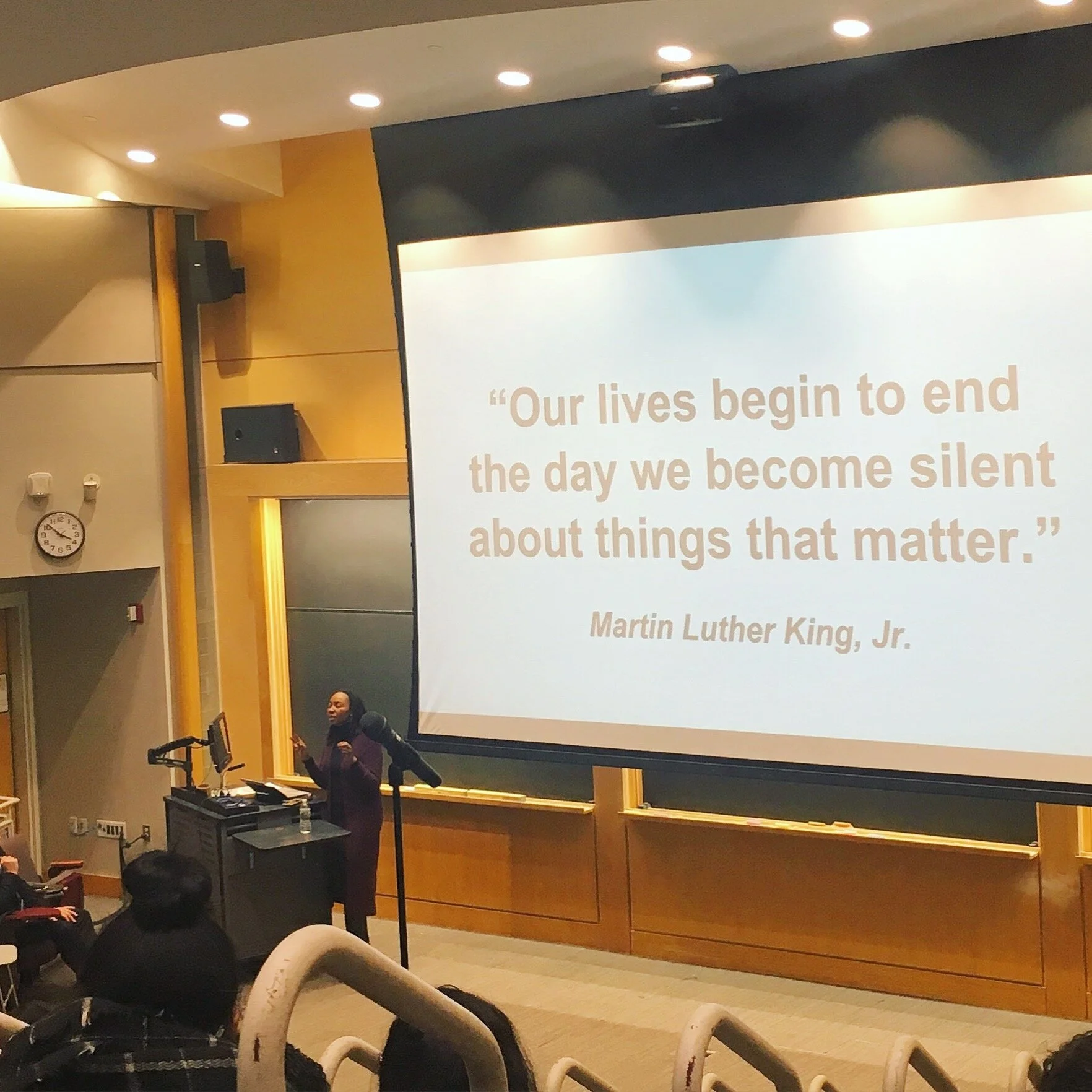
This past Saturday, the Brown community got to hear from one of the nation’s leading and most relevant activists, Opal Tometi. Tometi, co-founder of the #BlackLivesMatter movement and organization, spoke to a diverse crowd on the history of the movement, where the movement has been and where the movement is going as a part of the Sarah Doyle Women's Center Women's History Month series.During the lecture, Tometi walked us through some of the key milestones for the movement, including the events of Ferguson, the Trayvon Martin shooting, and the subsequent George Zimmerman acquittal, which brought the three founders together under the #BlackLivesMatter hashtag. She also spoke on the guiding principles of the movement, which include lifting up many narratives, particularly those of black women, black trans-, black immigrant, and black disabled folks, while also highlighting global issues of anti-blackness.Before the lecture, Blog sat down with Tometi to learn more about her thoughts on the movement and its future. Blog: What are your own personal goals for and within the movement?Opal Tometi: My personal goals for and within the movement are to ensure that all black people are treated with dignity and respect. That they are celebrated in all of their identities, and that all of their experiences are uplifted in the movement. I think that ultimately, similar to the quote that Audre Lorde is really known by, “There is no such thing as a single issue struggle because we don’t live single issue lives.” And I think that’s true and so there are many [folks] in the movement who are impacted by a number of different issues and a number of different systems and I think it’s really important to acknowledge that and to have a movement that is truly reflective of that. Of all of the needs and all of the aspirations of all of black people, so that’s ultimately what I want to see.I also want to see that the global black community is involved in this, right? So I don’t think that this is only about black people who reside in the United States; it’s about black people who live throughout the globe and, in particular, the African continent. A number of things are going on in terms of foreign trade policy and different types of banking and loan agreements that have really destabilized African nations, and I think it’s really important that we take that into account and that we support the struggles that are going on in different parts of the globe. And so, ultimately, I want to see that. I want to see a really integrated and innovative movement. I think we are seeing a little bit of that now, I think that there’s a lot more to come and I think that ultimately the goal of the movement is to have a multiracial society that truly works for all of us, and that means that Black Lives Matter has to be central to that. You know, we don’t have a multiracial society that works for all of us if black lives don’t matter.Blog: Do you see the Black Lives Matter movement venturing into the political, following moves like DeRay Mckesson in Baltimore?OT: I think that there are a number of different strategies for different people in the movement and different organizations in the movement. For our organization, I think that there might be some folks who decide to do some sort of electoral strategy or political strategy in that realm, but, however, I think that we are ultimately more concerned with the structures and the culture in our society. Right now we know that there are really a number of laws on the books that should make what is going on across the country illegal, or it is illegal, or it’s wrong. However, the implementation of those laws and policies are not, so I think that that speaks more to the culture of our society and the valuation of black lives as opposed to are the right people in elected position and so on.This is the thing, right: so we have more black elected officials than we’ve ever had in human history in the United States, yet we still have these types of atrocities happening every day in our society. And so I don’t think it’s a natural course of action to say...“Oh, if we have more black elected officials things are going to be better.” We need the right types of leaders in our communities who are actually going to transform these systems and not just conform to the systems, or not just be there to get their own power. We need people who are actually going to do something with the power and leverage it, and really make important structural changes that are meaningful for us.I mean, I’m not going to run for office. That’s not what my goal or aspiration is. There are just some more fundamental things that need to take place in our society and the electoral strategy is but one strategy, and the political is but one aspect of our lives. And it’s an important aspect, but it’s not everything. So I think we’ll see a number of different strategies being employed.Blog: Now that the movement has become so large, how do you recenter it around your organization’s original principles, particularly centering folks at the margins?OT: Well, it’s a movement so we don’t control it. People are doing what they want to do and there are a number of organizations in the larger movement ecosystem and, so, I think what we can do as an organization–that we actually started in Ferguson because people decided to go and really support the folks on the ground–we did a Black Lives Matter freedom ride in 2014. But that’s not when we started; we started in 2013 and it was more of a rallying cry and I created the online tools and things like that for more people to connect, and actually to connect with other organizations because Black Lives Matter wasn’t an organization at that point. We became an organization in 2014 coming out of Labor Day Weekend.I think our power is in the fact that we have a particular set of principles and politic that does center folks from the margins, and we have 32 chapters and we’re growing, right, so we’re all across the country and we’re also in Canada. I think that all we can do is be a strong organization and keep organizing in our communities and know that we have allied organizations across the country that also share these beliefs. So we’re not the only ones; I don’t think we have to control or act like we’re the only one. You know, there’s Black Youth Project, there’s Million Hoodies, there’s my other organization, the Black Alliance for Just Immigration, which is the country’s only immigrant rights group for people of African descent–we’ve been around for 10 years. There are a number of groups, essentially, that are doing this really, really important and needed work that share the same analysis.I think if people read and pay attention and, you know, listen to what we’re actually saying, they hear it and understand it and we’re transforming the way that politics, in the broader sense, is being done. And I think we’re seeing some shifts. I see a lot more of black queer, black trans-, black immigrant, black disabled...just different folks who are really being uplifted in our movement and finally getting a little bit more airtime. But it’s not enough. I would never say that it’s enough but we’re pushing it, and I think that with collaboration with these other organizations we’ll see a lot more of that.Blog: Do you see the more recent spurts of racial violence as backlash to this movement and perhaps even the Obama presidency? Or do you think that there is an increase at all or is there just more of an oversaturation within the media?OT: Well we know that black people who are unarmed have been killed by vigilantes, by law enforcement, by security guards every 28 hours. That’s been well documented for a very long time. I think that there may be some increases right now, but I think that it’s actually that we’re seeing it more and it’s being caught on camera a lot more as people are utilizing their camera phones and so on to document and to share. And so I think that’s actually been really helpful in terms of making sure that our people know what’s going on on the ground.There has absolutely been a backlash to the Obama presidency and that’s, I mean it’s eight years now, and so I think there’s been an ongoing backlash. I think a lot of it first kind of centered around immigrants, and there’s been a lot of anti-migrant sentiment. A lot of anti-immigrant rights sentiment that emerged during the first few years of Obama’s presidency. I think many people didn’t put two and two together in that when things change at that level all the bigots come out, and the folks who are just going crazy. So we saw a backlash and a whole bunch of anti-immigrant laws emerge in that context–and even now–and spread across the country. Those laws, though, also started to occur at the same time as other laws people weren’t paying attention to–so, for example, in Arizona there was a ban on Affirmative Action and that kind of only caught traction after the anti-immigrant laws were set. There was a ban on Ethnic Studies that only happened after these anti-immigrant laws so there was a way to disguise what was going on and to say "It’s only about law and order, it’s about immigration, don’t pay attention, it’s rational." But really it was about all people of color, and it particularly was developed in an anti-black context, really building off of an anti-blackness as the kind of the main way that people are informed about what to do and how to value people and so on.Blog: Going off of that, do you think that media attention, though necessary to the movement, has in any way hurt the movement by diluting the messages or perpetuating images of racial violence?OT: No, I think what’s powerful about Black Lives Matter is that we created our own echochamber. When I reached out to Alicia to basically say "Hey, I think this actually should be a platform, we should build out a website, and I’m going to do all these things," it was so that we had more control of our own narrative. So I think that what I’m most concerned about is us using our own platforms, sharing our own stories in our own voices, our own perspectives, and that to me is really powerful and has been incredibly successful and was what allowed us to breakthrough to the mainstream media. I think the reality is that people still pay attention to traditional press, traditional media. So we do have to contend for our stories, our narratives to be really accurate and accurately reflected in those venues.However, at the same time, I don’t think we can be reliant on it. I think we need to be diligent about making our own platforms that really reflect who we are and our own aspirations. I think it’s important that people know the stories about people who are being brutalized, but do I want to see it every single day? No. I tune out all the time. I don’t watch videos, you know, I deliberately turn things off and, sadly, there have been times when I had to watch it. I’m at the gym and they start flashing the scene of Eric Garner being choked to death and you can’t avoid it. So there’s some times you can’t avoid it, and I remember sitting down with my youngest brother who is a teenager and we were watching the news one day and he saw Laquan McDonald being shot in Chicago and he was kind of like "Why? What happened? What did he do?” So all of these questions that young people are having to grapple with, you know, I just hate that they have to be subject to that type of violence and to really see themselves as being potential victims of that kind of racialized, young violence. It’s disconcerting. It’s very disconcerting. I think we have to do our work to make sure we don’t get desensitized to the types of violence that we’re seeing. And I think at times we do have to not show it; I think that there’s times when it doesn’t make sense to continue to replay and replay and replay.I don’t want to become accustomed to black death. I’m NOT accustomed to black death and I do things to intentionally make sure that I’m not, right? So that I can cry, so that I can be outraged, so that I can mourn, so that I can love. I think it’s really important that we maintain that connection to the sacredness of life. And sometimes the ways the media portrays you, not only in Hollywood and pop culture, but also in the very real existence of our lives can feel very bleak. Can feel very disheartening and we just have to be mindful of the images we’re taking in and then the meaning making that’s happening as a result of these images.Image via Deena Butt '16.