
Virgie Tovar: Fat Feminism(s) and the Language of Anti/Assimilation
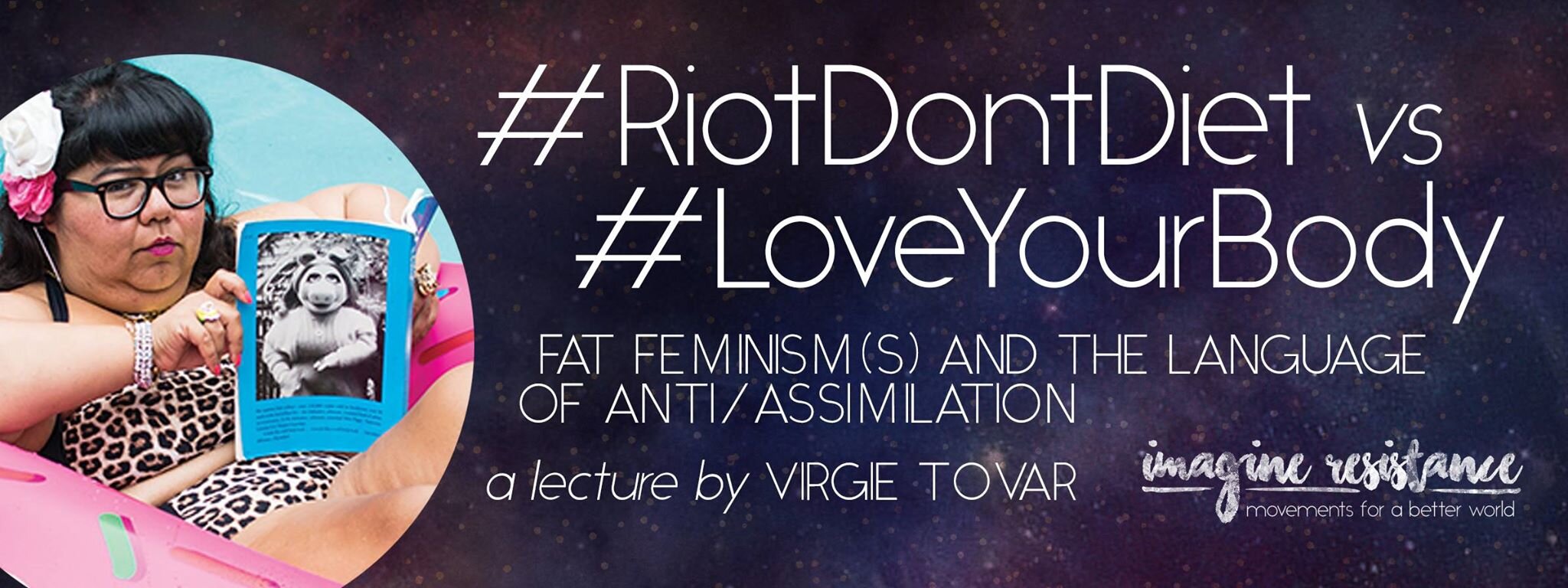
Virgie Tovar is an author, activist, and leading expert on fat discrimination and body image. She is a plus-size style writer for Buzzfeed and the creator of the fat-positive hashtag #LoseHateNotWeight. She has a master’s degree in Human Sexuality and taught Female Sexuality at the University of California at Berkeley. Now, she tours the country speaking about fat feminism and the ways that body image and diet culture intersect with race, gender, class, and sexuality. She was the first lecturer in the Sarah Doyle Women's Center Women's History Series this month.Tovar began her lecture by speaking of her own identity, and how fat, gender, and race intersected within it. Tovar showed the audience various pictures of her younger self, before she was self-conscious of her weight. She argued that, to herself and many other people in America, the adoption of internalized fatphobia and the resulting self-hate typically occurs around the age of five, citing a study that found that five-year-old children would rather lose an arm, be hit by a truck, or have a parent die of cancer than be fat.She continued by deconstructing what the term dieting has meant for her. She defined dieting as “any behavior done with the goal of losing weight for moral or aesthetic reasons.” Tovar recounted the story of her time abroad during college, in which she ate only spoonfuls of food while in Italy and developed scurvy. Tovar now identifies as a “recovering dieter."Diet culture, according to Tovar, is the cultural system that values and normalizes things like calorie-counting, and food-associated shame, and even holiday-related binges (like Christmas or Thanksgiving) and their subsequent restriction. Tovar noted that while fatphobia and diet culture are most oppressive of fat people, they actually oppress everyone. As she put it, “either you’re actively being fat-shamed or you’re terrified of being fat-shamed.”In addition to name-calling and outright rejection on the basis of weight, fatphobia manifests in various institutional forms–such as restrictive size of seating in classrooms, decreased availability of clothing, and diminished access to meaningful relationships. Tovar was also very explicit in noting that other marginalized identities such as being a woman, being LGBTQ, having a disability, or being a person of color, increase the severity of the oppression of fatphobia.Various movements, publications, and events held mostly in the 1970s featured mainly queer women attempting to reclaim their own fat bodies (such as Fat Girl Zine, the group Fat Chance, and the event ‘Let it all hang out’). Tovar noted that their history in the LGBTQ community is often unintentionally erased, just in the way that people of color, people with disabilities, and transgender/non-binary people are often excluded from the modern fat-positivity movement.The latter portion of Tovar’s lecture involved her discussing and critiquing various fat-positive hashtags used in recent social media, as she argued that “the internet is the battleground for contemporary feminist issues.”The talk focused on four hashtags, #EffYourBeautyStandards, #HealthyAtEverySize, #RiotNotDiet, and #GlorifyObesity.The first of these was a hashtag started by Tess Holliday (the largest plus-size model to be signed to a mainstream modeling agency) that was up to 1.2 million tags on Instagram as of March 8. Tovar argued that this hashtag’s message operates by expanding the concept of beauty outside of the conventions traditionally held by our society to include fat people; however, she critiqued the hashtag for not being applicable to non-white cisgender women, and for failing to divorce a woman’s value from their beauty. #HealthyAtEverySize is a hashtag often used with photos of fat people exercising, eating vegetables or doing other stereotypically “healthy” activites. Tovar acknowledged that being fat and being healthy are by no means mutually-exclusive. However, she critiqued the tag for implying that being fat is only acceptable if someone exercises or eats vegetables or does other “healthy” things. Tovar contended that health as a concept is poorly-defined, and that someone shouldn’t have to conform to our cultural ideas of health in order to be accepted for their bodies. Tovar then spoke about #RiotNotDiet, a movement that she praised for turning the energy of the movement off of fat people and onto society. #GlorifyObesity is another tag Tovar views as inherently anti-assimilationist as a satirical response to the medicalization of fat bodies. Glorifying obesity is exactly what modern culture would tell you not to do, and it is both “aggressive and whimsical.” Tovar said that the tag “hyperbolizes our cultural anxieties about fat people," reclaims the word "obesity," which is often used to pathologize fatness in a way that is controlling and shaming of fat people for their perceived lack of health, and helps to reduce its stigma.