
Challenging the Brazilian national myth of racial democracy
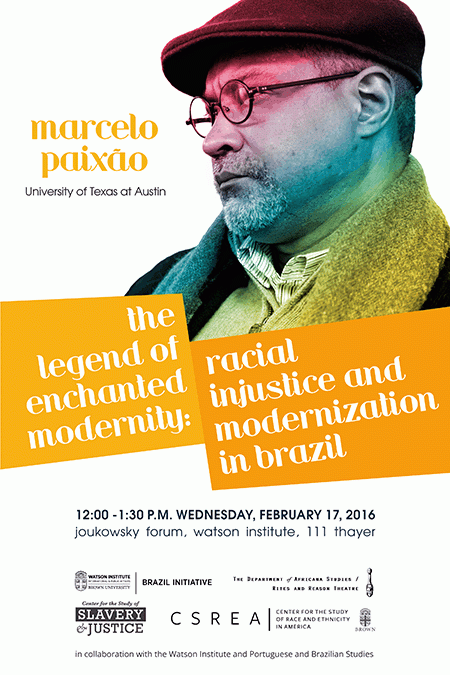
On Wednesday, Professor Marcelo Paixão, of the University of Texas at Austin, spoke at the Watson Institute regarding the central question of his research on race in Brazil: Why has "racial democracy" endured as a Brazilian national myth for so long? After all, the U.S. and Brazil were founded on the exploitation of enslaved Africans, and both countries have maintained massive racial inequalities since. Why do these inequalities, though of similar origin, figure so differently in the national discourses of the two countries?Paixão explained that racial democracy is the idea that all races exist peacefully in Brazil and that there are no racism or racial divides in the country. Unlike in the US, where racial divisions are widely recognized and discussed as a prominent figure in contemporary society, Brazil's national discourse presents the vision of a people unified in a nationhood that transcends race. The deep racial inequalities that persist in the country are overlooked (at least by the government and white society) as acknowledgement of such disparities would threaten the core narrative of Brazilian nationhood.Paixão opened his talk by dismissing the premise of racial democracy in Brazil as ridiculous. How can a nation, founded on slavery, in which Afro-Brazilians remain politically, socially, and economically marginalized, claim to be free of racism? The government and white population refuse to see this reality, said Paixão.He would know: he played a key role in spearheading the movement for affirmative action in Brazil. The government has resisted adopting affirmative action policies, as doing so would acknowledge that racial disparities exist in the country and are the consequence of still-evident racist attitudes and policies. This, of course, would be tantamount to destroying the discursive pillars that uphold Brazil's national "mythology."Paixão then discussed how this narrative emerged. It came into the national discourse when Brazil was striving to become a modernized nation in the 1930s and wanted to portray itself as a unified country. The Brazilian government pointed to the fact that the majority of the country was mixed-race to argue that racism didn't exist. This discourse continues to this day, denying the lived experiences of people who find their employment opportunities, housing options, and social standing dictated by societal perceptions of their skin color.Paixão's research, which has quantified racism by aggregating and analyzing statistics of racial inequality, has largely fallen on deaf ears in Brazilian society and government. Though his work to advance affirmative action in the country has produced tangible results, even statistical analyses that demonstrate clear racial inequalities have thus far not compelled the government to act in any meaningful way.According to Paixão, just for racial equality to become an expressed goal in Brazil, a fundamental struggle to redefine the nation's mythology needs to take place. In the meantime, academics like Paixão are stockpiling the intellectual ammunition necessary to carry on that fight.Image via.