
The American Dream, God, and the Meaning of Life
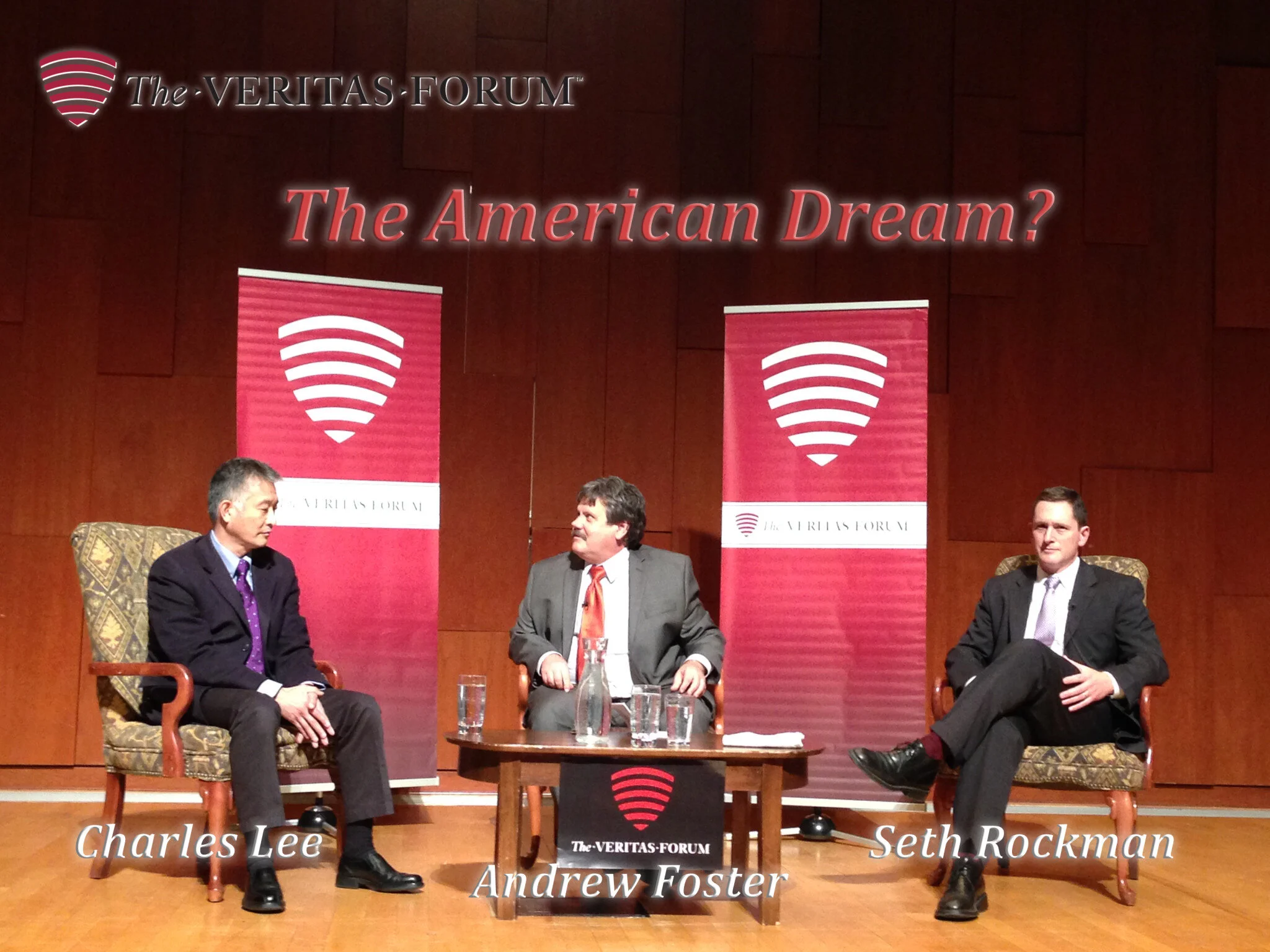
The Veritas Forum is an event that strives to bridge the gap between the religious and nonreligious at Brown, and introduce people of all beliefs to ideas surrounding faith and morality. It is run in a Q&A discussion format with a moderator and two speakers—one Christian and one non-Christian. Thursday’s discussion "The American Dream?" touched on these topics in relation to success and the pursuit of happiness in the United States.The forum began with a series of interactive questions projected on the screen, to which the audience could text responses. These elicited chuckles when people realized the responses—some less serious that others—were updated in real time for everyone to see. After the crowd of one hundred or so students, faculty, and community members filtered into the auditorium Aidan Cron ‘19 introduced the speakers:Seth Rockman, a professor at Brown specializing in the 19th century United States History with a focus on the relationship of slavery and capitalism in American economic and social development.Charles Lee, a business professor at Stanford and former Managing Director at Barclays Global Investors, a firm with over $300 Billion in active equity strategies. Andrew Foster, the moderator of the debate and a Professor of Economics, Health Services Policy and Practice, and the Director of the Population Studies and Training Center at Brown.The discussion kicked off with a message that may have disappointed those in the audience looking for fireworks:“This is not a debate,” Cron explained.The purpose of the forum was to challenge the audience through discussion. For Christians, it was a chance to question existing beliefs, while for those who thought of the Christianity as irrelevant or mystifying, it was an opportunity to see faith through a different lens.Throughout the talk, the two speakers, Rockman and Lee had different, but not necessarily contradictory views on what defined success.Rockman took on the American dream from a historical perspective, citing his own family background as a struggle to improve the economic and educational upbringing of one’s children. He described his family history from immigrant great great grandparents, to a grandfather with an office job, and finally to higher education. Still, Rockman made it clear that his family’s version of the American Dream was something that was a lot harder for African Americans to attain, from a segregated and unequal public education system, to redlining, and racist provisions that limited social security benefits.Lee, the Professor of Management at Stanford, agreed with Rockman, but brought up how the American dream is tied to finding significance in life.“We want our children to grow up in a place with meaning and purpose,” he said.Andrew Foster, the moderator commented on how it seemed Lee, Rockman, and most of the students had reached the pinnacle of the American dream.“Look around. We’re at an Ivy League institution. It doesn’t get much more educated than this. I hope for the good of all of us that your children won’t be wealthier than you are.” This received some laughs from the audience.“Should we have a definition of success that isn’t tied to moving up the education or wealth distribution ladder?” Foster said.Rockman pointed to the pursuit of occupations providing meaning, contentment and purpose as an alternate view. “This comes to you when you become a parent and you start thinking about their outcome,” Rockman said.“While working at McKinsey is exciting, so is going to Brooklyn and making artisanal pickles.” Lee agreed and pointed to Mark Zuckerberg, who recently committed donating 99% of his wealth to charity upon the birth of his daughter.“We want our children to grow up in a place with meaning and purpose. Jesus is aspirational because he gave it all up to solve a problem that others could not solve.” The speakers had different views when proposed with the task of creating a society that provides for everyone.Rockman took a top-down approach to the question, focussing on identifying and replacing economic and political systems that create inequality, with something with moral substance.“We need to create good institutions. This goes beyond enforcement of law or social justice. These things matter a great deal, but there needs to be some sense of trying to improve the world.”Lee on the other hand, believed that societal inequalities stemmed from answering the question: why are people inherently selfish rather than selfless? “There is no question that Jesus’s calling to us is to help work to alleviate human tragedy and suffering,” he said.Lee then went on to echo Jesus’s encouragements regarding money: give generously, give quietly, and give intentionally.Both speakers acknowledged the importance of security in ensuring a fulfilling life. “In our political moment we are very concerned about security and safety. Some are afraid of ISIS while others are afraid of the Brown Police,” Rockman said.For Lee, the focus was more internal. He discussed the role of Adam and Eve in the Bible, who realized their nakedness and shame after committing the original sin. He explained that fear, shame, denial are the reasons behind why self worth “goes up and down every day.”Lee said that the only way to limit such internal chaos was to understand the soul. “Even if you know all the how to’s, it’s still important to ask why?”The speakers concluded the discussion on an optimistic note. Lee noted that nothing in life has an intrinsic value without personal substantive values. “It’s about priority. What do you put first in your life?” For him specifically, this came through the Bible, which he compared to an insurance card his daughter once found.“You may find that you still are covered.”Rockman, who acknowledged, that as the non-believer he has served as “the wet blanket” for a largely Christian audience, talked about the fine line between rationalization and finding truth.He spoke of a hypothetical 23 year-old managing consultant overseeing the firing of much older, experienced workers, yet rationalizing his work as bettering society through efficiency. He compared this to his own avoidance of rationalizing that he can make sweeping social changes through history. “Writing books about slaves in the 1790s is not on the fast track to making capitalism less exploitive. I have come to be able to live with that. Being a radical historian is different from being a radical. Recognize you are in the midst of an ongoing conversation.”