
Blocked
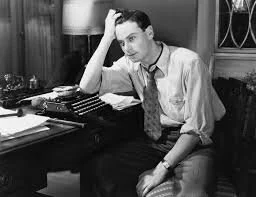
When asked about writer’s block, Aaron Sorkin— a writer I admire very much— denies that it exists. He says writers exist in a state of having no good ideas. And, every once in a while, the writer manages to make a little progress. It isn’t writers’ block so much as it is life, with dots of writing in between. The writing process, for Sorkin, “takes me months and months of doing what to the untrained eye what might look a lot like lying on the couch and watching ESPN.”
On the one hand, this is comforting. I don’t watch ESPN (because of the sports), but I’ve found a million equivalent ways of wasting time. And it’s nice to know that an Academy Award-winning screenwriter (The Social Network, The West Wing) goes through the same process of accomplishing just about anything except what needs to be done. On the other hand, the man has an Academy Award, so there must’ve been a point where he turned off ESPN, sat down, and wrote kick-ass Mark Zuckerberg dialogue. It’s all well and good to procrastinate as much as Aaron Sorkin, as long as you can sit down and write like Aaron Sorkin afterwards. And that’s where it gets tricky.
I had an idea for a play in April. I pitched it to people as “a comedy about the Lincoln assassination,” which got everyone’s attention, but also got me some weird looks. It’s actually a farce about the actors and actresses who were backstage at Ford’s Theatre on the night of the Lincoln assassination, based on a very comprehensive historical account with the inventive title Backstage at the Lincoln Assassination. I knew I wouldn’t have any motivation to write without deadlines, so I told everyone I knew that I was going to write this play. I got into contact with the author of the book and started peppering him with questions. I did opposition research to make sure no one had already written a play on this idea (they have, it’s terrible, I’m not worried), and, most of all, I made sure everyone knew that I would be finished by the end of the summer.
You can probably guess where this is headed.
Manufacturing your own deadlines only works if you take yourself seriously. And as the summer progressed, half of my brain began to realize that, actually, no one was forcing me to finish this play. Do something else! it said. Go outside and play! it said. The other half of my brain was very persistent in continuing to tell everyone that I’d be finished by the end of the summer. Sure, you can read it soon! it said. Yep, next week is gonna be a week of writing! it said. The end result of this incredible teamwork is that I managed to promise the entire world a play and then just didn’t deliver. Summer creates the illusion of infinite time, so why would I do anything now when I could do it all tomorrow?
School has the opposite effect, and in a really stunning instance of nearsightedness I told everyone that I would finish the play as soon as I got back to college. Y’know, in my free time. Then I started rehearsing a musical and shooting a student film and writing long, brooding blog posts about writer’s block instead of actually getting any writing done. Even in the rare moments when I’ve had a few hours to spare, my resting heart rate at college is so jittery that I rarely find myself in a place to take a breath and think about the play. The last bit of dialogue I actually wrote, God-knows-how-many-moons-ago, was:
HELEN: I’m sorry?
I could just end the play there and call it avant-garde, but I’m hopeful that, any day now, one of those moments of not-writer’s-block will hit, and I’ll make progress toward something that people can actually read and watch, instead of something people can just hear me talk about. If all other motivation fails, my friends bought me a poster of Abraham Lincoln for my birthday that now hangs directly above my desk and stares disapprovingly at me. So now I can’t give up on this play, because then I’d just be that guy with an Abraham Lincoln poster in his room and nothing to show for it.