
SATC: Osmosis and Diffusion
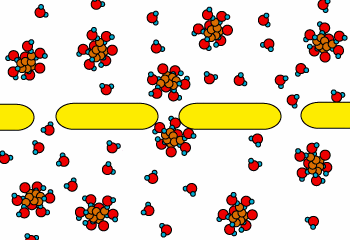
“Oh my god, did you hear about the scientists who revived dead pig brains??” My friend Sabrina leans across the table at Andrews, careful not to spill her curry. “Crazytown. I can’t believe it.”I nod, grinning at her usage of the word “crazytown.” In our senior year of high school, my friend Maya coined the term, and I quickly picked it up. When I moved across the country, I often forgot that “crazytown” is unique to her vocabulary and I'd get a weird look or a chuckle whenever I said it. But now my friends at Brown have started using the innovative compound word themselves. “That’s wild,” I agree. The conversation turns to other things: classes, weekend plans, the truly mystifying interior decoration of the Andrews walls and upholstery. Every now and again, someone says something that would not have been a part of their vocabulary only a few months ago. I can’t help smiling; I realize that we know each other now, well enough to share each others’ idiosyncrasies, well enough for me to track the changes in my own expressions and to notice the phrases my friends have picked up from me.Until my roommate brought it up the other day, I hadn't thought about osmosis and diffusion since 11th grade Chemistry. I was telling her how the boy down the hall had supposedly woken up outside in the cold, miles away from campus without shoes or a phone, after a wild Saturday night. In my retelling, I used the word “cracked” to describe how unusual and ridiculous I found this most recent rumor. “Cracked?” She was confused, her voice raised at the end to indicate her question.I asked her if she hadn’t heard Sabrina saying it, then commented on the way that people tend to pick up mannerisms and phrases from each other when they spend a lot of time together. She agreed: “Osmosis and diffusion,” she said. “Osmosis and diffusion.”Your vocabulary is supposed to expand when you’re in college. Weekly readings introduce tongue twisters and gibberish disguised as jargon and words that mean different things when they are capitalized. But since I've been here, I’ve noticed other changes, too.For example, I’ve never been one to call people “honey.” In fact, one of my cousins has a cringe-inducing habit of calling me hunnny, the nnn dragged out in condescending affection. But when I was added to a Snapchat group called HUNNIE$Z, the word suddenly adopted a new meaning. Every Tuesday, the members of HUNNIE$Z convene at Andrews for curry night. We greet each other in high pitched variations of the word and spend the night laughing so loudly that the other patrons of Andrews fine dining turn to stare or glare. Another friend of mine has taken to quoting Broad City in a significant majority of our conversations. Specifically, she mimics the lines “I baby, baby cannot pay,” from the episode in which Fred Armisen hires Ilana and Abbi to clean his apartment but then appears in an oversized sweater, claiming that he is a baby and can only “pay in blocks.” At first, I hated the phrase more than anything. The exaggerated vocal fry and the odd sentiment made me uncomfortable, but I put up with it because I love my friend and there are certainly stranger things she could quote from the show. But in the last few days, I’ve caught myself parroting the very same Broad City scene when I don’t want to spend money on this weekend’s party or am lost/confused/overwhelmed — in other words, whenever I feel like a baby.To diffuse light is to evenly spread illumination so as to reduce glare and harsh shadows. Maybe this symbiotic exchange of habits is a similar attempt to find a certain degree of uniformity. Customs and quirks spread evenly between a group of people make it easier to communicate, to connect. Absorption is a good way to take in culture. Sometimes it can be jarring; other times, it can be so subtle that you don’t even notice the change.It amazes me how people who know nothing about one another find ways to give and take until they're speaking the same language. People can get used to so much. It makes me wonder what other habits I've unconsciously picked up since I've been at school. What other things have I grown used to over the past few months?I’ve gotten used to the sound of my roommate’s fan at night, to walking across campus until my toes hurt, to sharing showers and sinks with girls who don't always remember they are sharing said bathroom. I’ve become attuned to the rhythm of the week, developed routines, and discovered my favorite places to study. I've memorized the rotating dining hall menus (though I still forget that the Ivy Room is closed on Fridays and it breaks my heart every time). I used to leave my laundry in the washing machine for hours without a second thought; now I set an alarm, often neglecting my clothing anyway, but not without a second thought. I used to eat dinner at nine p.m. every night, but now I get hangry if I don’t eat before seven.Getting used to change is hard, but it comes naturally with time. It’s astonishing, really, to think about the things I’ve adjusted to; it’s crazytown. There are some things I’ve become perhaps too accustomed to. For example, all of my meals are made up of the same ingredients organized in different ways. Sometimes too-drunk boys at frat parties get closer to me than I’d like, but they’re drunk, I think to myself, and this is a college party, after all. I almost agree that stealing from the dining halls is okay because theft protection is included in the cost of our meal plans (who did I hear that from? Is that even true?). I've gotten used to the fact that people spend hundreds of dollars on alcohol and off-campus parties every month, or buy new $80 makeup products while complaining that their parents don’t give them enough allowance. It's easy to forget that we live on a hill and that everyone on this campus is either a professor or between the ages of 17 and 23 (honestly, sometimes seeing a baby or toddler freaks me out).Confronting the unfamiliar can be fun and innocuous, like adding the word "cracked" to my vocabulary. It can be challenging, too, forcing me to question the things I take for granted, things that I agree with or concede to just because they seem normal in the bubble of Brown's culture. But I steadfastly refuse to get so used to the changing seasons that I no longer appreciate the colors of fall on the east coast or the awe of spring after a real winter. I’ll try to change up my meals and get off campus more, walk down to India Point Park or Fleet Library. Try to spice things up, remind myself that unfamiliar things exist. If I can find a balance between the familiar and unfamiliar, I can adjust to change without sacrificing parts of myself.I don't want to let my new environment and the habits I've acquired from it subsume the person I was before. It’s not a practice of layering or of burying older parts of myself beneath newer ones. It’s more like concentric circles expanding outward. We reach into unfamiliar spheres as we draw closer to one another, overlapping like Venn diagrams. As we do so, words and phrases and gestures and opinions and ideas (et al.) start to travel across perimeter lines.Osmosis and diffusion, osmosis and diffusion.