
SATC: Name of the Game
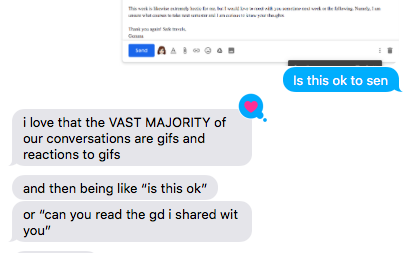
My phone is on its last legs. I tell myself I don’t care, that all I really need it for is texting and calling people, but I know I’d be hopelessly lost without Google Maps and catch a serious case of FOMO without Snapchat. Opening apps sometimes crashes the entire system and recently I have been unable to make phone calls without the call dropping before it even rings. IPHONE STORAGE FULL, it yells at me every time I try to take a picture. I open the Photos app, scroll through trying to find pictures I’m willing to delete. Embarrassingly, there are quite a few screenshots of text conversations. I delete all of those and laugh at myself. I don’t really need so much advice on how to communicate with other people, but it feels good to get confirmation that I’m making the correct strategic move before sending a text into the void. I apologize to my friends for asking them such trivial questions, but they tell me not to worry and ask me the same ones. The summer before tenth grade, I sent a screenshot to the very person whose messages I had screen-shotted. He was my first boyfriend, although I didn’t know he was my boyfriend until I broke up with him. He never actually asked me out, but lamented the lost relationship (which, again, I was unaware of) when the summer, and our camp counselor jobs, came to an end. It was right out of Grease: we went to the beach, and he kissed me on the ferris wheel, first asking if it was ok that he did so because he was sick. It was not the best first kiss, but it could have been worse, I know. I wish he’d worn leather pants like Danny Zuko or driven a cool car (even though we still only had driver’s permits); that would have at least made the story stand out. Instead, and probably for the best, it was a pretty average experience. He sent me texts that said such deeply romantic things as, “hi how are u,” or attached voice memo recordings of him playing guitar. I would see his name pop up on my phone and my stomach would drop to my feet. When I accidentally sent him that fatal screenshot, I was mortified. I didn’t know what to do. I wished I could un-send the text. I wished I hadn’t participated in the “mind games” I thought he was playing, hadn’t felt like I had lost some imagined upper hand and had to confer with a friend to regain my footing.Instead, all I could do was send him a follow-up text that read: “I just wanted to show you how crazy you sounded.” I was pretty proud of myself. This was not the first or last time I would fall prey to the “game” analogy that, ironically enough, takes all the fun out of relationships. In this situation, at least, fun and games do not go together. I’ve agonized over the specific wording of texts, my own and others’. I’ve waited an hour and a half to text someone back after they’d taken an hour and twenty to respond to me. I’ve scrolled through the list of people who have watched my Snapchat story, analyzing the appearance and order of the Bitmoji avatars. I’ve pretended to have fun at parties to prove someone wrong, I’ve laughed at jokes I don’t think are funny, I’ve made references I actually know nothing about. And, of course, I’ve sent screenshots to friends for approval and commentary, and, once, to “show someone how crazy they sounded.”Thinking of relationships as games doesn’t make sense to me. The analogy implies that there is a winner and a loser. Do we over-analyze each other because we’re so used to thinking of communication as a game? Or do we think of it as a game because that’s often how it feels when we’re experiencing it? Like most things, it’s probably both. (If you’ve read the last few SATC's, you’ll notice a recurring theme: everyone is full of contradictions, things are complicated, and all of it together is a knot that is impossible to untie.)Usually, people aren’t really thinking that much about you. I mean that in the kindest way. Usually, people think about others in terms of the way they are perceived; we all want to be liked, we all think more about what others think of us than we actually think about others. So, when I’m not quite sure why someone’s left my text on read, I try to remind myself that they’re probably not thinking so hard about the decisions they make, that I’m the one making meaning out of what may be meaningless.That’s not to say that my interpretation is invalid, or that everyone is instinctually selfish, or even that it’s okay for someone to leave me on read. People are bad at communication. It may true and it may be understandable, but that doesn’t make it okay. I’m not suggesting we resign ourselves to poor communication; rather, I’m trying to understand that sometimes people say and do confusing things, and when faced with the choice to sit with confusion or jump to conclusions that may very well land me in the wrong place.There is so, so much space bridging the distance between what I say and what you hear. Of course, there are each of our lived experiences and individual perspectives. There are also the signs we’ve been taught to pick up on, the ways we are instructed to interpret certain archetypal situations. If someone is mean to you, for example, it could mean they like you…It didn’t take me long to realize that Henry Garvey, the boy who pushed me off the monkey bars on the second day of kindergarten, did not do so because he had a crush on me. My mom was furious, and the teachers made him apologize, so I thought the matter had been resolved. It bothered me that his apology seemed insincere, reluctantly extracted by the teachers. It also bothered me that he continued to call me names and bump my elbow to mess up my drawings. He never did push me again, though.My mom probably told me Henry had a crush on me because she wanted to spare my feelings. Similarly, reading into texts and vocal intonation and confusing choices is a very effective defense mechanism; equipped with an arsenal of strategic moves and an understanding of our opponents’ tactics, we can protect ourselves with a barrier of speculations. That’s just it: we put up barriers. We construct layers and layers of meaning to fill that space between us. I think it makes sense, trying to set some ground rules, trying to establish a framework so navigating unfamiliar territory feels just a bit familiar. But why are these rules based so much on assumptions? Why don’t we just ask each other what we really mean?Because: that’s terrifying. What if someone doesn’t text me back because they just don’t like me? What if someone says they can’t make it to dinner because they actually just don’t want to go? One of my friends recently sent me a screenshot of her latest Google searches, which read, “What To Do When Someone Doesn’t Like You” and “How Not to Care When People Don’t Like You.” She had hooked up with an ex at a party, the girl she had come with waiting somewhere else in the house, wondering why she was being ignored by her date. She felt horrible, in part for abandoning her date, but mostly because she couldn’t stand the thought of someone out in the world holding a negative opinion of her. The other girl, I imagine, was trying to understand why she suddenly felt like she’d lost a game she’d never agreed to play in the first place. “Here’s the thing,” I told her, “Not everyone’s going to like you.”And it’s true, there are people who don’t like me. I just have to try to be okay with that. I’d rather not play games, I’d rather not fill the space between myself and others with assumptions and misinterpretations. If that means coming to terms with the fact that some people don’t like me, that sometimes my feelings will get hurt, and that Henry does not, in fact, hold a special place for me in his heart, I think I’ll survive. Even though the rules of the game occasionally make sense, and even more rarely can result in a win, I’m realizing I’m not here to win. If I’m playing against someone, that means they’re playing against me. I don’t think setting each other up as opponents can ever really result in a reciprocal relationship. The other day, one of my friends held her phone up to her mouth and shouted at it, “stop playing games because it’s working!” She was not talking to the iPhone itself, or to Siri. She was annoyed because she felt herself falling into that same trap, and she didn’t know how not to play the game. It’s hard, I think, to step off the playing field if the other team is still running around with the ball.Sports analogies and battle terminology aside, I wonder if it really is possible not to jump to conclusions. The best I can do, right now at least, is remind myself that I don’t have any interest in playing games, even if I end up winning (and winning does feel good). I can try to be honest with myself and other people. I can try not to fill that space of interpretation with imagined meaning before anyone has gotten the chance to actually say or do anything. I can let you speak for yourself and try to do the same.