
What's Your Deal?: Scott Huson
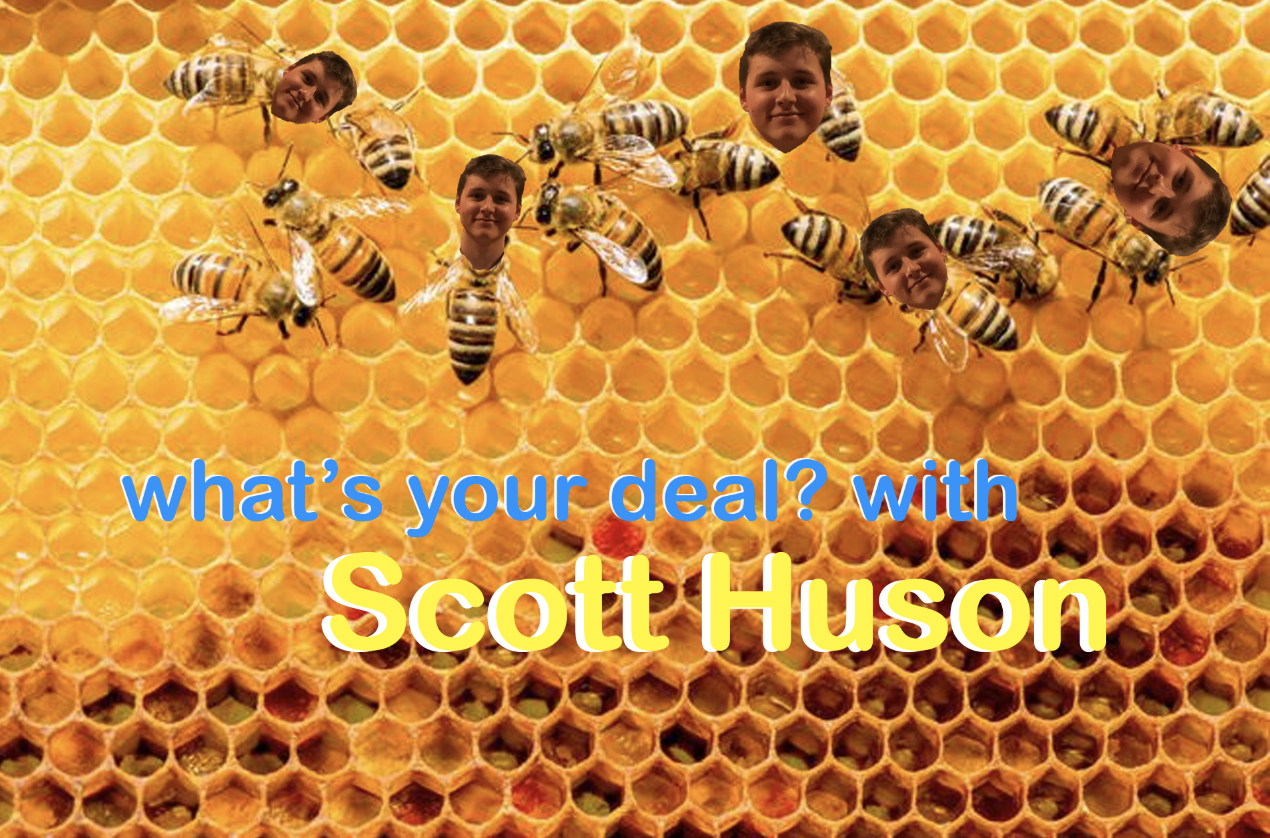
Bees are really neat. They dance, they count, and their work (pollination, mostly) is nothing but beneficial to the general public. Scott Huson ‘21.5, an allergic fan of bees, is also really neat. He too dances and counts, and his work is, more or less, beneficial to the general public. Scott is a founding member of the Brown Beekeeping Society, which came to campus this semester. He's also the sole proprietor of Brown Bytes, an online calendar that uses a Huson-made algorithm to accumulate all of the free food events on campus on one interface.Scott founded the Brown Beekeeping Society with the goal of not only keeping bees, but also of fighting other environmental issues through education and action. Bee-wise, the Brown Beekeeping Society been working with RISD's iteration, which currently owns and operates two hives in Providence. Scott’s experiences with beekeeping in high school taught him that such a niche issue could be reformatted and used as a platform to get the funding, space, and prestige necessary to bring in talented guest lecturers and to hold events such as honey workshops and candle workshops. The lecturers the Society plans to bring in will speak on a number of issues, such as science, politics, biology, and bees. Scott also hopes to feature at least one political candidate during the next election cycle.“I want to build a community of motivated students who can use use the Society however they want," Scott said. However, funding is sparse, because clubs at Brown are not financially supported by the University until their second year. To work around his financial limitations, Scott plans on borrowing equipment from the RISD club.
 When asked about the potential risks of beekeeping, Scott told us he doesn’t think anyone should be deterred by fear of being stung. He’s allergic to bees and has been stung “many times,” but he seems to be doing very okay. In fact, he says it's not even close to being the most dangerous club on campus. The most dangerous club, in his opinion, is the Brown Outing Club. The reason? They drive cars to get to their trips. The highway is definitely much scarier than a beehive. In addition to filling Brown’s beehive-shaped void, Scott has also worked to bridge the gap between food and unfed college students with Brown Bytes. The daily free-food calendar was born from Scott’s realization that there were numerous food-related resources students weren't taking advantage of, from Info Session Kabob & Curry or unused meal swipes. Scott has addressed the former with his algorithm and he's in the works to address the latter with his “Marketplace” concept, through which students with excess meal swipes can pair up with people that need them. He hopes to eventually set some sort of rate for such an exchange, but, regardless of a Brown Bytes currency, he hopes that the reduction in unused credits will help Brown curb waste. First, fewer credits will go to waste, but the process could also make it easier to estimate how much food should be made in a given year based on how many meal credits are left in the system by the end of the year.Scott doesn’t have a monopoly on the free-food-database market, nor the on free-food-database-name market. There’s Brown Bites on Facebook, which tries to list free food events; Brown Meal Share on Facebook, in which students can share credits and points; and there’s the Daily Herald’s Brown Bites Newsletter, which, as of two months ago, sends out a weekly email that includes free food listings. Yet Scott’s not intimidated by these competitors, and actually doesn’t even view them as competition. The more people consuming free food the better, he says.
 This confidence is easy to have when your product is immensely better than the rest, which seems to be the case; the Facebook page hasn’t been updated since December, and the Brown Bites weekly newsletter contains about three food listings an email, while Scott’s Brown Bytes lists two times that a day. But wait, as if Scott isn’t already cool enough, there’s more! Last year, three weeks into winter break, he realized he “felt as if [he] didn’t know enough about real life to know what [he] wanted to do in college.” So, using a connection from his older brother, he spent the next six months in Hong Kong doing web development and making manufacturing trips for a drone company. He says this experience led to him to come back with a clearer sense of how to take advantage of what Brown has to offer, a clear path that led to his mission to be involved and support his peers.Why else is Scott cool? Well, he's originally from Costa Rica and has lived in several countries throughout South America. He's fluent in Spanish. He takes Salsa dancing lessons in Alumnae Hall. His team won second place in Brown’s Datathon hosted just a few weeks ago, implementing a project for segmentation of neurons in mice and fruit flies using deep learning and neural networks. He has a nice smile. He likes bees. Bottom line: Scott’s a cool dude. If you want to meet the man contributing to campus culture, just become a member of the Beekeeping Society, take a dance class, spend a late night in the Sunlab, or join his team at Brown Bytes (he’ll buy you a meal)!Images via and Scott Huson '21.5.
