
10 Things We Learned at Make America White Again
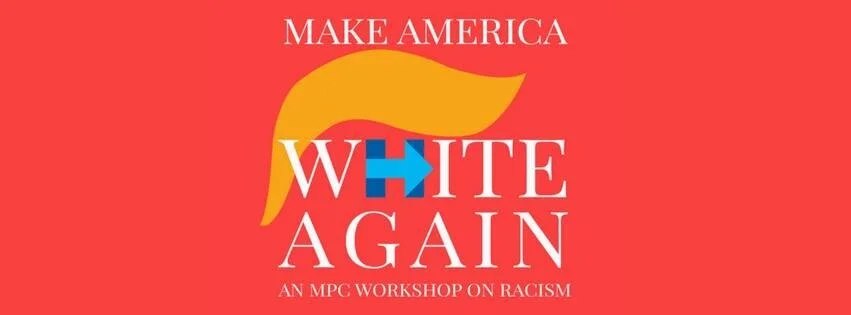
Last Tuesday night, the MPCs and the Brown Center for Students of Color (BCSC) gave a stellar workshop entitled "Make America White Again: An MPC Workshop on Racism." The facilitators of the workshop—namely, Khalif Andre, Helya Azadmanesh-Samimi, Kayla Cain, Brian Elizalde, and Uche Onwunaka—aimed to demonstrate that politics in the United States are consistently motivated by racism and white supremacy and to exemplify the racist tendencies, policies, and actions of both Donald Trump and Hillary Clinton.Here are 10 things we learned at “Make America White Again:”(Content Warning: Racism, Anti-Blackness, Xenophobia)1. Everybody, from political candidates to history textbook writers to, particularly, white America in general, needs to stop blindly venerating the Founding Fathers. Ben Franklin said, “The number of purely white people in the world is proportionally very small... I wish their numbers were increased… But [maybe] I am partial to the complexion of my country, [because] that… is natural to mankind” and Thomas Jefferson referred to people of color as “pests in society.” Let’s please stop talking about them like they’re some sort of ideal that we’ve lost in American politics. 10 of the first 12 presidents owned slaves-- Good riddance!  2.The two-party system in this country was built on racism and still fails to represent the interests and voices of people of color to this day. The Democratic Party, founded in 1828, was pro-slavery, and the Republican Party, founded in 1854, though against slavery, was not against racism. Abraham Lincoln, one of the first leaders of the Republican Party, whom Americans likes to herald as the “man who freed the slaves,” said that he could “conceive of no greater calamity than the assimilation of the Negro into [white] social and political life as an equal.” After Democratic president Lyndon B. Johnson signed the Civil Rights Act of 1962, Black voters moved from the Republican party to the Democratic party. The Republican party attracted white voters disillusioned by the Democratic party's efforts to include minorities within its voter base following the Civil Rights Movement. 3.Stepping into the modern era, the facilitators highlighted the racially disparate and clearly unjust “War on Drugs,” which criminalizes black and brown people and largely ignores drug use by white people in order to continue America’s legacy of white supremacy. The War on Drugs is arguably the largest contributor to the system of mass incarceration in the US. This video gives a nice overview of it. 4.Capitalism, which was defined as a socioeconomic system that relies on the exploitation of many for the benefit of the few, upholds racism both historically and currently. In the 1830s, the US government began the Trail of Tears, which was the forced relocation of various Native American tribes (especially the Cherokee) from their ancestral homelands in the Southern United States to reservations west of the Mississippi River. Of the 16,000 Cherokee people removed, 4,000-8,000 died along the way. This relocation was done to free up land for white people to farm as well as to enable white people to access the gold discovered in the Georgia Gold Rush of 1828. Today, the prison industrial complex ensures that various industries and the government itself benefit financially from slave labor in prisons, giving a profit incentive for more people of color to be incarcerated. 5.Islamophobia and the War on Terror have become racialized. Racialization is the process of ascribing ethnic or racial identities to a social practice or group that did not identify itself as such. In the United States, Muslims have become victims of race-based violence through the construction of a visible stereotype of “Muslim,” focusing on markers such as name, dress, color, physical features and language. Once racialized, Islam inscribes onto Middle Eastern, and South Asian POC a homogenized visible archetype of “Muslim” that simultaneously legitimizes and racializes Islam. This affects the way that terrorism is viewed in the US because, even though there is a significant history of white Americans committing acts of terrorism (the KKK, the Charleston Church Shooting, US interventions in various other nations, etc), popular media only uses the term “terrorism” when referring to actions of brown people and other people of color.
 6.While the Democratic platform’s stance on immigration is much better for undocumented immigrants than the Republican platform today, this issue is not so cut and dry. Ronald Reagan actually gave amnesty to 3 million undocumented immigrants during his presidency, whereas, during Obama’s presidency, detentions and deportations hit record levels. Like Islamophobia, immigration is also an issue that has become racialized. The US spends 4 billion dollars more on the border with Mexico than the border with Canada. What does this say about whose exclusion the government has prioritized? 7.Both candidates use dog-whistle politics, which are political strategies, statements, and slogans that convey a controversial, secondary message in which politicians use language that does not directly refer to race yet hint at stereotypes associated with a specific race. In 1996, Hillary Clinton famously referred to young gang members as “superpredators. No conscience. No empathy.” While she never actually refers to race in her statement, the context of the quote and the inextricable linkage of Black people and gangs in modern US culture means that her description demonizes and condemns Black youth. Donald Trump also employs dog whistles often, most notably in his slogan: “Make America Great Again.” When exactly were the “good ‘ol days,” and who exactly were they good for? The answer is all of the time in the past when white men had more power over others and weren’t constrained from openly saying offensive things by a culture of political correctness. This concept is better explained by (content warning: racial slurs and anti-blackness) this quote from Lee Atwater, one of Reagan’s top advisers. 8.Donald Trump is extremely racist. His language, policies, and ideas affirm and perpetuate various racist stereotypes still distressingly prevalent in the culture and collective psyche of the US. He has used fear mongering and hate speech in order to divide white people and people of color for his own gain. For example, Trump continually says that crime in the US is “out of control” and has declared himself the “Law and Order” candidate, a stance that mainly involves increasing the policing and criminalization of people of color (see War on Drugs video). However, a recent FBI study found that violent crime rates are at the lowest they have been in 30 years. 9.While Hillary is a less overtly racist candidate than Donald Trump, that doesn’t excuse her racist behavior in the past. Clinton was instrumental in the implementation of the War on Drugs that continues to uphold the system of mass incarceration in the US. Additionally, Clinton supported a military coup in Honduras in 2009 that ousted a democratically elected leader and resulted in numerous human rights violations. 10.There are tons of ways people can resist these systems of oppression. The first example brought up was the ongoing fight against the construction of the Dakota Access Pipeline (DAPL) by the Standing Rock Sioux, a Native American tribe whose land and waterways would be crossed (and potentially polluted) by the oil pipe. Then, members of the audience were asked to share how they fight racist institutions. Here are some of the things Brown students do to resist:
- Educate themselves and uplift others.
- Emphasize Black beauty and deconstruct Eurocentric beauty conventions.
- Affirm Black women and Black feminine people.
- Let themselves be angry.
- Laugh, take up space, cultivate spaces.
- Reclaim spaces made through Black labor.
- Sag their pants when they walk around Brown University to resist the respectability politic imposed on Black bodies in white spaces.