
How much are you worth on the internet?
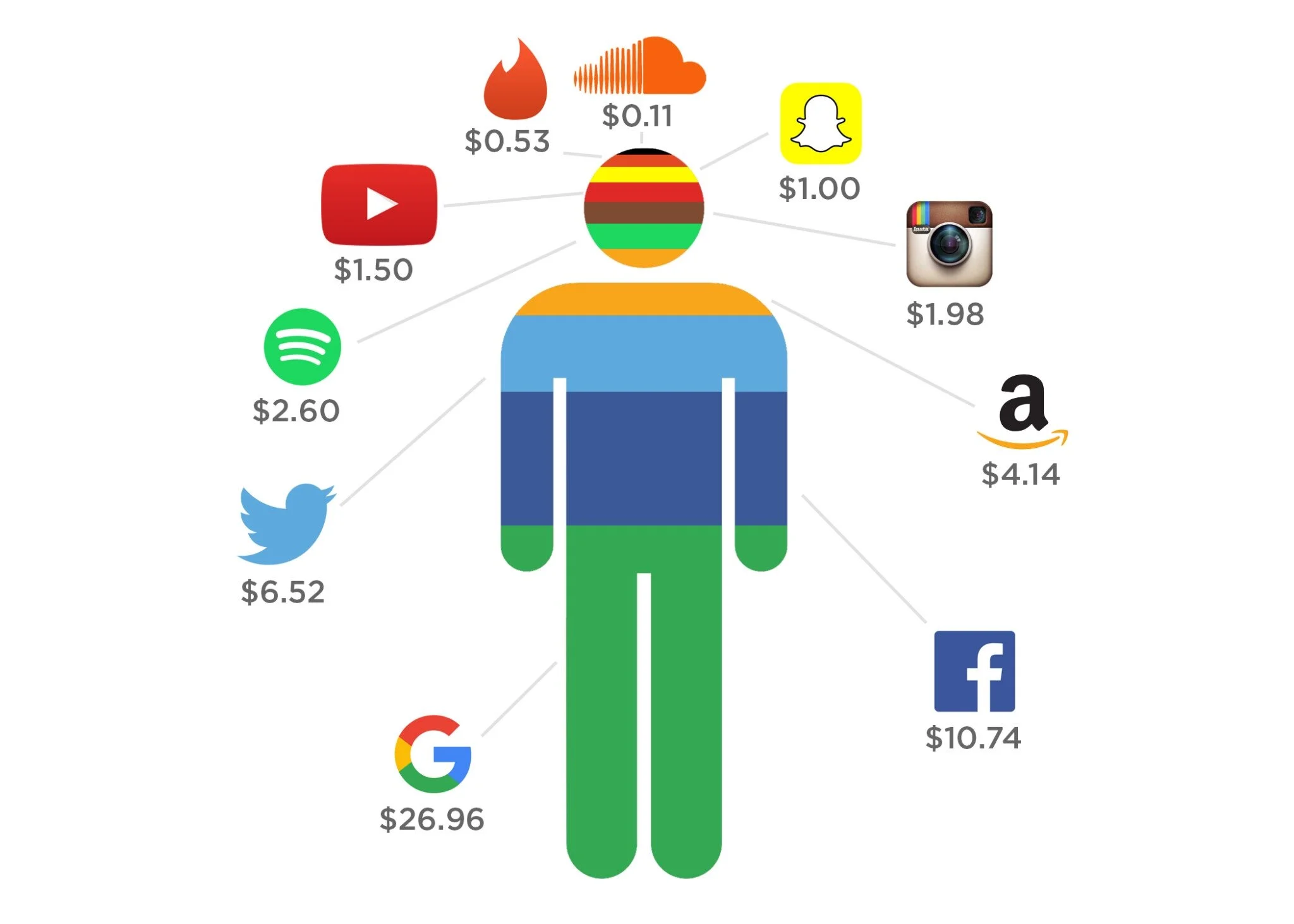
The average student today cannot live without generating data online. With every "Accept these terms" and "Allow cookies" tab we thoughtlessly click, we are exposing more of our personal internet habits to marketers and advertisers, making us all extremely valuable. In fact, the 2016 projected market size of online big data is $232 billion.Historically, advertising has been an extremely lucrative business in newspapers and television, but now that our every click can be tracked by cookies (a tiny file that your browser keeps to know what you've already clicked on), websites can generate information that makes ads more effective than ever before.To give you an idea of roughly how valuable you are, we've taken a list of the most common sites and apps used by the average Brown student and found a dollar figure for the annual worth of your data to that site. This was done by taking the annual advertising revenue from each of these websites or apps and dividing that revenue by the total number of non-subscription paying users. With this model, here's rough estimate of how much your data is worth to these companies on a yearly basis and found the following, represented in the graphic above:
Google: $26.96; Facebook: $10.74; Twitter: $6.52; Amazon; $4.14; Spotify: $2.60; Instagram: $1.98; Youtube: $1.50; Snapchat: $1.00; Tinder: $0.53; Soundcloud: $0.11
This calculation is prone to some inaccuracy because Brown students will be more or less valuable than the average user for numerous reasons. For example, being from a younger demographic gives them less disposable income and more data generation while attending an elite private school is assumed to denote higher family income by advertisers. You may also notice that there is some overlap due to company ownership (i.e. Facebook and Instagram or Google and Youtube), but we took that into account and separated the results.The internet data market runs under the oft-cited mantra, "If you're not paying for a service, you're not a customer, you're a product." While internet users pay to have access to wifi, they generally do not pay the sites that that they visit. In other words, an online experience is a free service that is monetized through user data. If users opt out of this implicit bargain, there is a free-rider problem."Even though users value their privacy, they are generally not willing to pay for it," said Timothy Edgar, Senior Fellow of International and Public Affairs and Professor of Cyber Security at Brown.Our unwillingness to pay may be due to the fact that we generally don't notice any invasion to our privacy. At most, users might find that a company they Googled will end up showing an ad on their Instagram feed. However, the less visible issue arises from major internet players setting the rules for privacy without government oversight. This legislative model creates more tension in the post-Snowden era, when these large companies that make the rules are also criticized for getting too cozy with the NSA.Reversing data markets at this point is most likely impossible; our online experience will continue to be monetized. However, altering the markets to give the user more control over personal data is not impossible. In an article for the World Economic Forum, "Personal Data: The Emergence of a New Asset Class," Edgar and others question whether it is possible to enforce a market mechanism that allows consumers to control and trade their own data. At the moment no such system exists, but one of its kind would give data rights, and presumably privacy rights, back to the user.Image via Kenji Endo '18.