
Kevin Roose: "How to Write Nonfiction on the Internet without Hating Yourself"
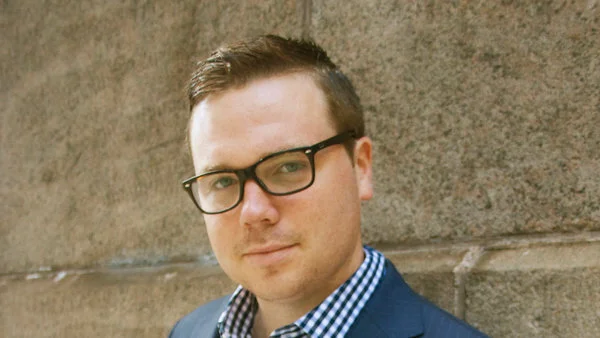
On Thursday night, Kevin Roose ’09.5 delivered a talk titled “How to Write Nonfiction on the Internet without Hating Yourself” as part of the Great Brown Nonfiction Writers’ Lecture Series. Interested in writing since his freshman year at Brown, Roose wrote his first book, The Unlikely Disciple, about his semester as a student a Liberty University, an evangelical college in Virginia. It was published while he was a senior at Brown. If that didn’t make you feel inadequate enough, he published a second book about young Wall Street bankers, Young Money, five years later while also working as a reporter for The New York Times. He now works as the news director at the multimedia company Fusion, a joint venture between ABC and Univision, where he also produces an online show.If this wasn’t obvious already, Roose has always been the kind of person to go for what he wants. The summer after his freshman year, Roose, on a whim, emailed writer A.J. Jacobs ’90 to ask if he was in need of a summer intern. Jacobs, known for his “stunt journalism” was in the process of writing his book The Year of Living Biblically, in which he wrote about his yearlong experiment following all the rules of the Bible. He’d found himself stuck when many of the biblical tenets involved the treatment of slaves. A few months later, Roose was in New York as A.J. Jacobs’ “biblical slave."It was while traveling with Jacobs that Roose found himself at Liberty University, a school that fascinated him with its unusual rules: no drinking, no dancing, no R-rated movies, no hugging for more than three seconds. Encouraged by Jacobs, Roose decided to spend a semester at Liberty during his sophomore year and write a book about it, even though he’d never written something longer than ten pages in his life. He sold a book proposal before he even started the semester, and two years later, the book was published.As Roose transitioned to talking about his later jobs in journalism, he spoke about the current state of media and nonfiction writing. “Print newspapers are dead, and print magazines are on life support,” he said. Media is changing more rapidly than it ever has, and he said, contrary to the beliefs of many, there has never been a better moment to be a young writer. (We can all breathe a collective sigh of relief now.)When Roose went to New York magazine, there was a clear divide between bloggers and people who wrote for print. Those people even sat in a separate area, which Roose and his fellow online writers called “Scriberia.” Roose preferred blogging in many ways, though, because he got to be a “regular part of the conversation.” Blogging was less formal and gave him a greater amount of creative freedom to write what he wanted. Still, the power lay in Scriberia. Suddenly, though, the dynamic changed. As online media grew in popularity and legitimacy, Roose noticed the respected writers started coming to the bloggers for help about how to approach social media and adapt their stories for this new evolution of journalism. These twenty-somethings had knowledge and skills that seasoned professionals lacked. “An intern was more immediately valuable than a Pulitzer Prize winner,” Roose said.Roose ended his talk with what he called his “Ten Commandments”:
- Don’t work for free if you can avoid it. Though this often seems unavoidable at times, Roose urged young writers to save their work and time for someone who will pay them.
- Your age is the biggest asset you have in journalism. Roose emphasized multiple times in his talk that our youth allows us to understand certain aspects of the media that people only a few years older simply cannot. The things we do on a day-to-day basis are our strengths.
- Fake expertise convincingly. Very few people really know what they’re doing most of the time. If you pretend you’ve got things figured out for long enough, one day you actually will.
- Specialize in topics, diversify in formats. It is extraordinarily useful in writing to be an expert in something. However, having the ability to move between different formats (video, blogging, social media) is an equally important skill.
- Balance stock and flow. Using economic terms, Roose stressed the importance of writing diverse types of pieces. Flow is essentially our “feed,” or our more disposable pieces of work, such as blog posts and tweets, that are only immediately relevant. Stock is the “durable stuff” that we put more time into and that people can still read months or even years from now.
- What you write is more important than where you write it. The quality of your writing almost always outweighs the name of the place it was published.
- Understand comparative advantage. Do what you’re good at. If you have some sort of edge, use it. Roose couldn’t have written his first book if he weren’t a college student. He was writing something few other writers could. Realize the ways you might have a unique perspective on a story or topic.
- Practice horizontal loyalty. While many young journalists suck up to their superiors because they think it’ll get them ahead, very few treat their peers with the same respect. However, Roose said, those people on your level will end up being more helpful to you, so be nice to them.
- Prestige is overrated. Roose left The New York Times and New York magazine to work for a company few people have heard of, but his job excites him and allows him to do work he could not do at those places. Young companies often present a wider range of opportunities and further training than more established publications.
- If you don’t say yes to adventure, you’ll live a very boring life. This one pretty much speaks for itself.
So go forth, young writers! Be young and keep doing what you’re doing!Now all those hours on Instagram and Snapchat are research, obviously.Image via.
