
Students protest anti-immigrant, racist, Islamophobic rhetoric against refugees
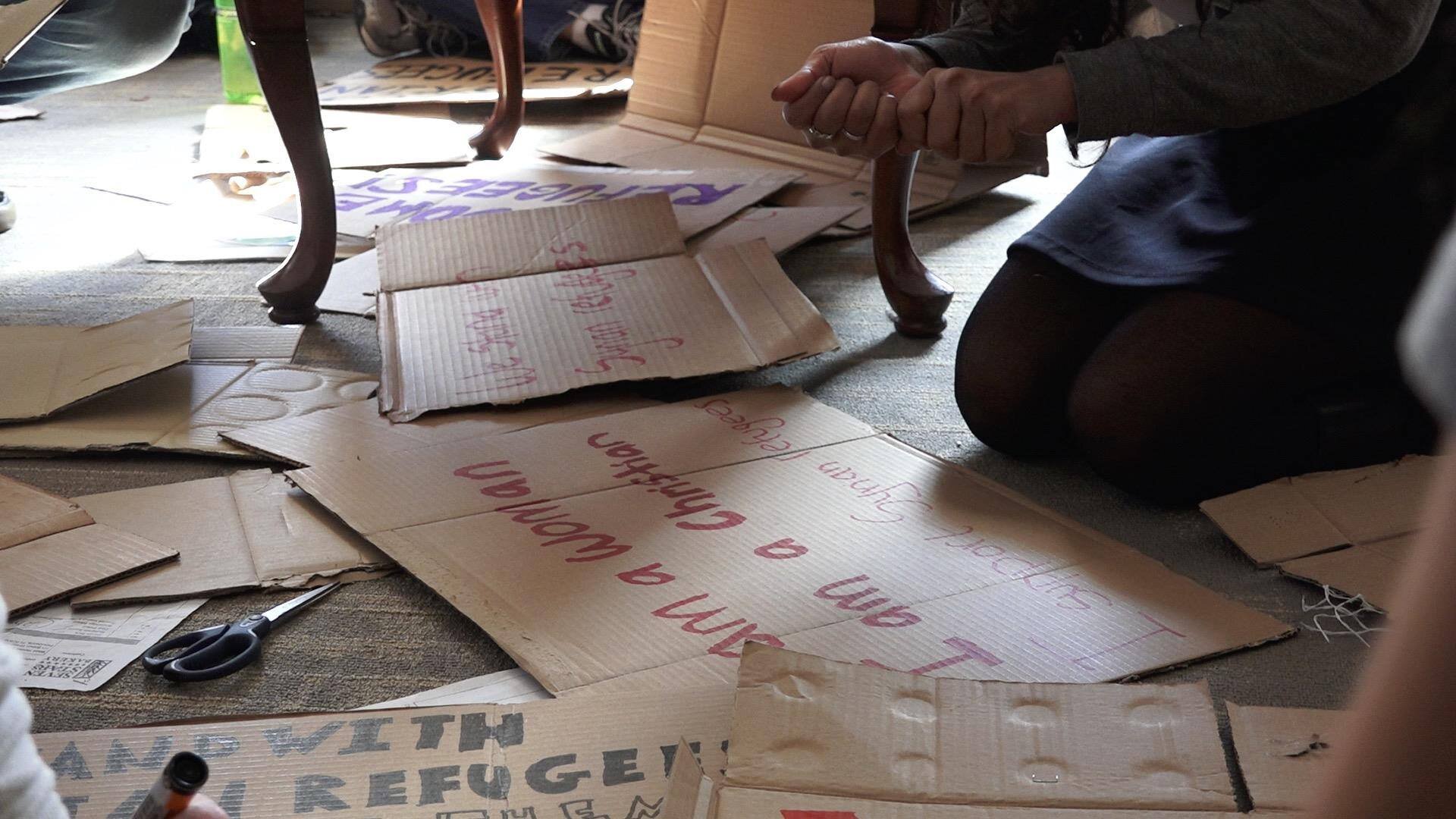
On Monday afternoon, upwards of 100 Brown students and 50 members of the Providence community gathered at the Rhode Island Statehouse to protest demands made to Governor Gina Raimondo to stop welcoming Syrian Refugees.The rally was organized by Nikhita Mendis '17 and Shireen Rummana '16 of Students for Justice in Palestine (SJP), along with Sana Siddiq '16 from the Muslim Students Association, and Rick Saleme '16, the head of the Arab Society.The gathering was in counter-protest to a press conference held by Dr. Charles Jacobs, President of Americans for Peace and Tolerance, who claimed that Syrian refugees have "deeply ingrained hatred of the West, especially of Jews, inculcated through Syrian educational intuitions – starting from childhood."Another press conference in support of the Governors open immigration policy hosted in collaboration by the Rhode Island State Council of Churches and Council on American-Islamic Relations immediately followed to "challenge stereotypes that Islam and the U.S. are somehow incompatible."https://vimeo.com/156636583The stereotypes being referred to were included in Jacobs' speech."We need to heed the lessons of Europe," he said. "We are inviting in people from a radicalized culture that rejects tolerance and teaches hatred of women, gays, Jews, Christians and Democracy.""It's simply not true. There's a huge Christian population in Syria and Syria has one of the most diverse Christian populations in the Middle East," said SJP member Peter Makhlouf '16. "These are the same discourses that Zionists are using in the context of Palestine, as well."Former Michigan Congressman Pete Heokstra also attended the conference to express his concerns about the acceptance of Syrian Refugees. When he spoke on the topic of genocide, a protestor interjected, asking, "What about genocide in Palestine?" A member of his team responded, "What Palestine?" The link between the Israel-Palestine crisis and the Syrian Revolution has been a main focus of SJP, a group that was originally founded to support the Palestinian cause. Outside of its role in organizing Monday's protest, SJP has focused its efforts on challenging the Western views on the Syrian Revolution that have portrayed the conflict as one of religious hostility and senseless violence.Last week, the group hosted a lecture to address the link connecting the two conflicts in more depth. The featured guests included Dr. Yasser Munif, a professor of political economy at Emerson University who spent time in the Syrian city of Manbij during its initial revolutionary period; Dr. Joseph Daher, who joined in on Skype and is a member of the Revolutionary Left Current in Syria and a writer and editor of Syria Freedom Forever and Nidal Bitari, a Palestinian-Syrian journalist from Yarmouk Refugee Camp in Damascus.Dr. Munif provided important context of the Syrian revolt and the Arab revolutions. According to Dr. Munif, the revolution is being viewed through an orientalist lens that ignores social and political aspirations of activists and chooses instead to reduce their actions to a violent and "savage" Arab other. The more important aspect, he claimed, are the desires of the Syrian people to move away from unequal post-colonial relations that disproportionately favor Western markets and that the Assad regime has maintained. Dr. Daher tied this into the context of Israel-Palestine, stating that the Israeli government favors regimes to popular uprisings since regimes are against Palestinian liberations while popular uprisings are not. According to Makhlouf, SJP wanted to bring Dr. Daher's perspective to the Brown community to illustrate the similarities in the goals of Palestinian liberation and the Syrian Revolution. "All the discourse now on Syria is geopolitical," Makhlouf said. "It's talking about the different groups, who's funding whom, where's the U.S., where's Putin, and we want to remove that." The Syrian revolution originated as a political uprising among the people. The Assad regime's suppression of the labor unions and teachers' unions that were at the heart of the revolution has generally removed the secular roots of the conflict from the Western eye. "We're always trying to be in solidarity with other struggles, not just for the sake of it, but specifically because [the Syrian struggle] sees the same structures of power," said Makhlouf.More videos from Monday's rally can be found here.Video and images via Oscar Dupuy d'Angeac '17