
ExHOTic Girls Wanted: An MPC Workshop
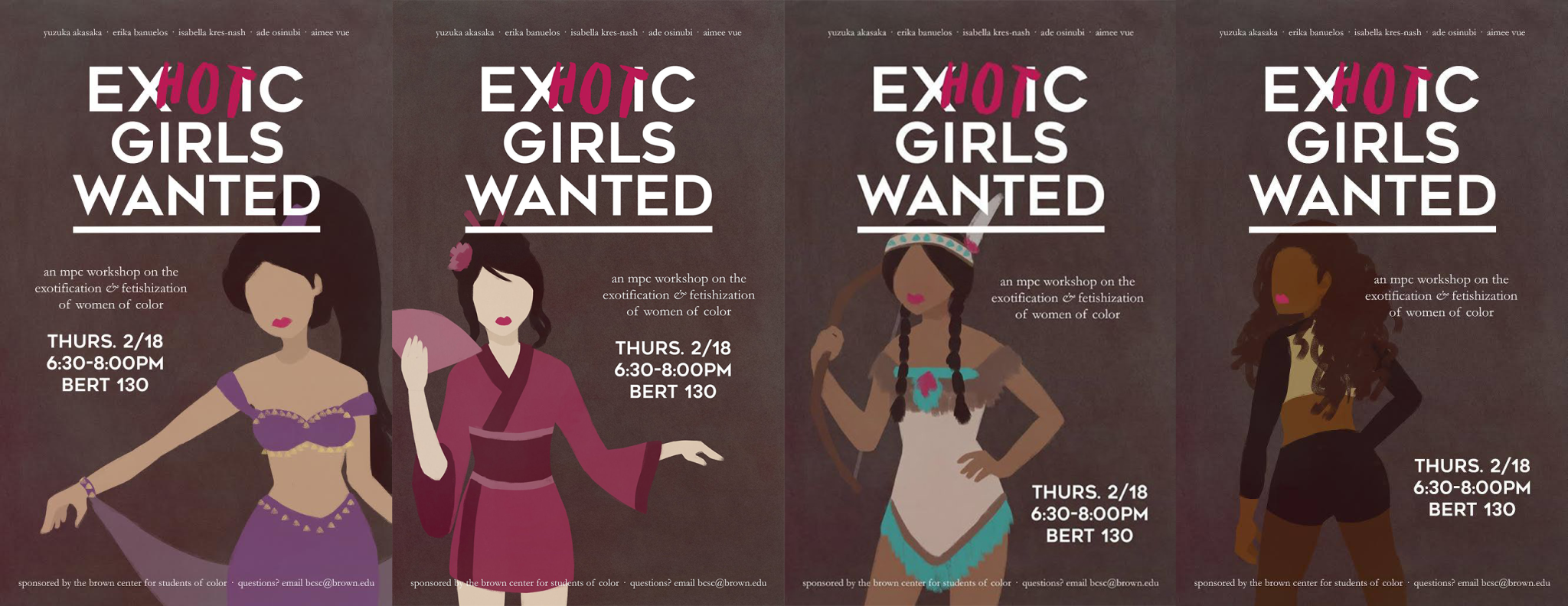
Have you ever been called “exotic” or asked, “So, what are you anyway?” What do those terms and phrases mean? Where did they originate? How do they affect women of color who hear it on a regular basis?These questions were examined in an MPC workshop sponsored by the Brown Center for Students of Color on Thursday night in BERT 130, titled “ExHOTic Girls Wanted: An MPC Workshop on the Exotification and & Fetishization of Women of Color." The facilitators, Yuzuka Akasaka ‘18, Erika Banuelos ‘18, Isabella Kres-Nash ‘18, Ade Osinubi ‘18, and Aimee Vue ‘18, all Minority Peer Counselors, delved into the roots of sexualized racial stereotypes while examining their continuity in entertainment outlets and the porn industry and their impact on women of color living in that reality.
After a short introduction, the audience was asked to yell out stereotypical words or phrases that are often used to describe Latina, Asian, Native, Southwest Asian/North African, and Black women.
The facilitators then examined the origins of these stereotypes. For Black women in America, sexualized stereotypical language was first used to describe Black slaves and the parts of their bodies that deviated from the traditional Eurocentric body standards, which turned slaves into public spectacles for the Western world. A famous example of this exotification is Saartjie Baartman, a woman of Khoi descent, who was brought to London during the early 19th century and put on display as a circus act to showcase her curvy features. Baartman eventually passed away in poverty, and the remains of her body were put on display in a French museum after being dissected by French naturalist George Cuvier.Baartman’s exhibitions helped perpetuate the notion that a Black woman’s body was a source of entertainment and something to be objectified and gazed upon. One participant talked about his experience of his mother being objectified when people publicly point out certain features of her body. Another individual pointed out a rumor that Beyoncé was going to play Baartman in a movie, though she has been guilty of Westernizing her physical appearance through lightening her skin and straightening her hair. The workshop then transitioned to sexualized stereotypes of Asian females. These stereotypes are connected to the “Madame Butterfly effect," which is the perception of Asian women as submissive and dependent on the Western male. Madame Chrysanthème, a popular 19th century novel, romanticized the storyline of the Western male traveling to an Asian country and finding a petite, doll-like Asian lover and eventually returning to his home, leading the Asian woman to commit suicide. “Yellow fever” stems from the White male perspective of Asian women as delicate sexual ornaments, an object to use and dispose of later.https://www.youtube.com/watch?v=Z6g32K4yAdsMost notably, the porn industry capitalizes on “exotic” women through its categories and video titles, as displayed in the above video. A participant remarked that these expectations prime adolescents before they even get to a sexual arena, convincing them that they can project these false notions onto their partners. More pressure is also put on women of color to perform as their stereotypes would, causing constant confusion and lack of pride in their own identities. Women can’t position themselves amongst these ubiquitous stereotypes that dominate media outlets because they are often demeaning and one-dimensional.To shed light on the prevalence of exotification in our immediate communities, personal narratives were submitted by anonymous individuals and read aloud by members of the audience. One such narrative was written by a Black model who was often forced to wear wigs or put into animal print clothing, pigeonholing her into a very narrow stereotype. All of these stories connect to the larger idea of desirability politics, or what characteristics are attractive to certain people and why. These notions of what it means to be attractive are often focused on or built around whiteness. Some audience members shared their own experiences of how white supremacy had affected their or their peers’ ideas of physical beauty, such as the effects of being one of the only Black students in a primarily white high school. Another person recalled being told how “lucky” she was that a white boy wanted to date her.
These “economies of attraction” play a role in online dating as well, and the workshop presented some statistics regarding which racial categories get the most responses, which are the most picky, and which are least likely to get replies.
https://www.youtube.com/watch?v=HjSh_esW9W4
To end the workshop, the facilitators presented the idea of “Radical Love," the notion of being intentional in resisting perpetuation of exotification and fetishization. Some of their propositions included reflecting on the reasons why you are attracted to a certain person and trying to be deliberate and thoughtful in your treatment of a potential partner. Their final suggestion was to understand that each partner’s pleasure and enjoyment of sexual experiences are equally important.
Additional resources for people grappling with these issues were provided at the end of the workshop, including Brown Center for Students of Color, Bluestockings Magazine, and Native Appropriations, among others.Images via Kyra Goldstein