
Inside the launch of the New York Times-Virtual Reality
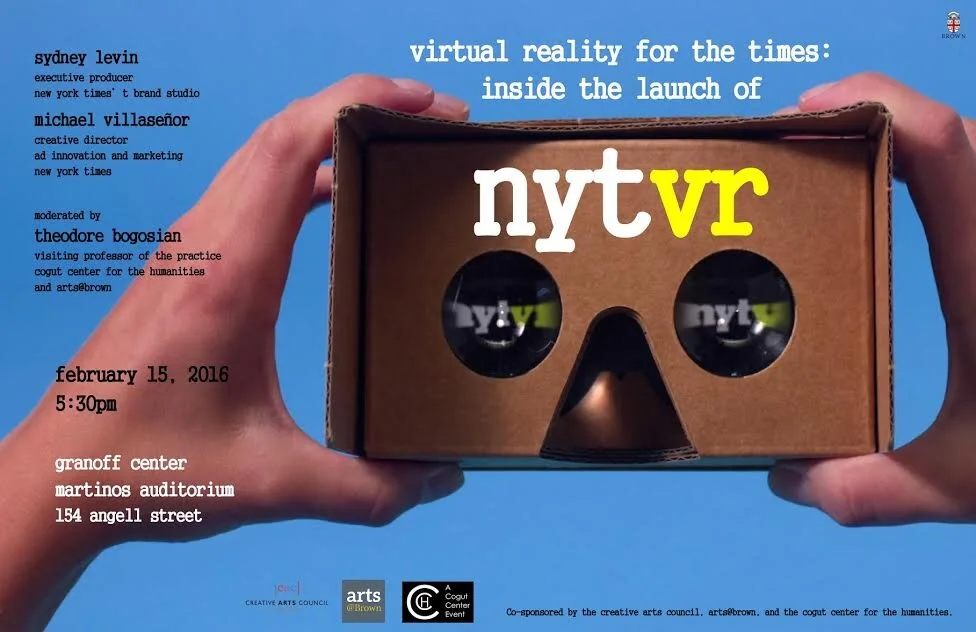
Last November, The New York Times unveiled a project a mere months in the making: NYT-Virtual Reality. A couple of days after the announcement, NYT’s subscribers found Google Cardboard goggles on their doorsteps, which brought them to worlds outside of their homes, thanks to the Times group of VR journalists.The discussion between Executive Producer Sydney Levin and Creative Director Michael Villaseñor was moderated by visiting Professor Theodore Bogosian (who teaches the Introduction to iPhone/iPad Moviemaking Using 3-D and 4-K Comparisons) and hosted through the Cogut Center for the Humanities. The conversation centered on the Times approach to innovative storytelling through new media such as VR.Like many innovations, NYT-VR was born out of introspection. Despite over a century as one of the top newspapers in the world, the Times feared losing relevancy in a media saturated world, explained Villaseñor. In 2014, the Times went through an internal self-examination to figure how the static paper-reading experience could be turned interactive. This resulted in the launch of fully integrated digital experiences through a variety of platforms, including VR.With VR, subscribers can experience a story as if they were physically there. A 360-degree camera records an entire area which the user can see with their own eyes. Villaseñor assured the crowd that soon there will even be sounds and user-agency as well.NYT-VR is not used solely for interactive journalism; the tech has also been used by the Times' T Brand Studios as a way to enhance native advertising. Native advertising–those sponsored posts on almost every website ranging from Buzzfeed to the Times to yours truly, the Blognonian–was reluctantly embraced by the Times as a more or less a necessary evil in the age of declining traditional advertising revenue. As executive producer, Levin combs through proposals from companies who ask the Times to create VR content to advertise on the T-Brand’s website (such as this interactive ad from General Electric).After the event, members of the audience were invited to play around with Google Cardboards, which let users drop into campaign events from presidential hopefuls or coast through rivers in foreign countries.Although they work at one of the top media companies in the world, Levin and Villaseñor were quick to emphasize the wealth of multimedia resources present at Brown, including the Cave in the Granoff Center and The Center for Computing and Visualization’s Yurt. Who knows...in a few years, you could be making the Times' VR content.